Home Blog Page 28

LIBC Purchases Loomis Trail

0

Golf Course Sale Has ‘Crazy Good’ Economic Significance

On Oct. 8, the Lummi Nation assumed ownership of the highly rated Loomis Trail Golf Course south of Blaine. Jay Julius, Chair of the Lummi Indian Business Council (LIBC), told Business Pulse in a phone interview that this transaction has “crazy good” economic significance, not only for the Lummi Nation but for all of Whatcom County.

The 180-acre property that includes the golf course, plus overnight and meeting space accommodations, sold for about $3.8 million, Julius said. He noted that the course, built-in 1995 and rated as high as No. 5 in the state by golf publications, has been “excellently maintained, (but) other parts of the property will need repairs and some love.”

Assessing the impact on the region, Julius said, “We’re the second-largest employer in the county,” adding that nearly 80% of the 1,300-plus employees combined at Silver Reef Hotel Casino Spa and in the Lummi government are non-tribal. “And this acquisition adds more county residents to that list.” All of the employees at Loomis Trail will remain in place, he said.

Julius described how the vision for Loomis Trail includes an economic boost virtually untapped in years past: hosting events, such as weddings and business meetings, and attracting recreational visitors to the 16 hotel rooms and 4,200 square feet of banquet space. Golf will serve as a value-added attraction for the Silver Reef (“we’ll lean on them for business and marketing savvy”). And Loomis Trail will become the home course for two high school golf teams—Lummi Nation School, which added the sport last year, and Ferndale High.

Julius spoke of how the purchase preserves cultural heritage: “Acquiring that course and land means that it will never be sold,” he said. In a public announcement he wrote, “It sits on original land of the Semiahmah. This is much more than a golf course. The Loomis Trail landholding is within our ancient ground…very important to the history of our people.”

An avid golfer himself, Julius said that a major consideration in the purchase was making it “affordably accessible to the public.” He said memberships would be available, too. “The main thing is that anybody can reserve a tee time. Golf is an expensive sport and we’re now able to change that from what previously has been a semiprivate course.”

Alice Clark and the Downtown Bellingham Partnership Bring Life to Urban Bellingham

0

Alice Clark has been synonymous with downtown Bellingham for 20 years. She sold pies at the Farmers Market, worked as a freelance graphic designer, helped create and nurture the Pickford Film Center, all downtown. And for the last three years she has served as Executive Director of Downtown Bellingham Partnership. In her fourth-floor office at the Bellingham National Bank Building, she recently visited with Business Pulse Editor Mike McKenzie and talked about how the Partnership builds on its tagline, “City of Renewed Excitement.”

You’re from St. Louis. How did you discover Bellingham?

I was newly married and my husband and I got on a motorcycle and rode up from St. Louis, through Canada, then down through Bellingham and into California. I can tell you five hours at a time on a motorcycle seat is the maximum anyone should do, trust me. We stopped to visit a friend from St. Louis who had come out here to go to WWU, and we instantly fell in love with the area.

We moved out here as we were both ready to start life on our own, away from our parents. We first lived out on the Lummi reservation and I got a job in Fairhaven as a cocktail waitress at The Hunt, a restaurant featuring a variety of mainly meat dishes directly underneath what is now Three French Hens.

Did your degree from Western Washington set your career path?

Maybe, in a roundabout way. I finished in 1997 in graphic design and illustration while raising (two) kids. After that I did freelance and independent contract work under my business, Matchbox Design & Illustration, and worked with a variety of local clients, including Business Pulse magazine. I volunteered as a graphic designer with a newly forming nonprofit, the Whatcom Film Association, which later became the Pickford Film Center. And that’s how I came upon my true calling­—community building through running nonprofits.

You’ve had your own businesses, too, right?

Yes. While the kids were younger and in elementary and middle school, I did landscaping, helping people with errands, whatever I could as “All-Around Alice.” I spent 13 years with the Pickford Film Center—11 as the Executive Director. It’s a nonprofit, but it’s also a business. After leading it through a multi-year, $3.25 million dollar capital campaign to build the new Pickford Film Center, I stepped down and took a short sabbatical and started Alice’s Pies soon after. I make a killer pie. What’s your favorite?

Coconut cream.

OK, then you’d enjoy mine—Triple Threat. It has toasted coconut in the graham cracker crust, high-quality coconut cream in the filling, which is topped with whipped cream dusted with more toasted coconut. It’s delicious!

How have these business experiences fed into your current position?

I learned a lot about how to manage people, staff as well as a board of directors. For example, I started the Pickford as a board member, became the board president and in doing so I learned a bunch about nonprofit management and board development. As a movie theater, the Pickford is also a business, so I learned about what it takes to run a business. Going through a large capital campaign also prepared me for this role, knowing what it takes to raise large amounts of money and what it means to renovate a building like we did with the Pickford on Bay Street.

Is most of your work with the Partnership spent managing?

I’m definitely the main orchestrator of it all, which does entail a lot of herding of various cats, but I also like to get into my own little pieces of programming that interest me. As a manager, I really love helping staff get engaged in their work, finding and developing their talents and truly enjoying their jobs.

How is Bellingham Downtown Partnership staffed?

We have five full-time and several part-time employees, some seasonal—like landscaping positions. Next Spring we plan to hire a part-time events assistant. We staff for communications, retail advocacy, business development, and events. Lindsay Payne Johnstone has been here the longest, and she manages events. She’s taken Downtown Sounds from a small happening in an alley to the large event it is today.

Does the Partnership require membership?

No. It used to, but that didn’t work out that well. What benefits are reasonable to offer? Administration of the membership takes time and resources. We had to ask, do we want to spend time figuring out all that, or working to bring in income from other revenue streams and partner with our constituents in different ways?

Now we serve anybody in the downtown core.

If no dues, what pays the freight?

We’re funded by businesses’ sponsorships of events, contracts with the City of Bellingham like landscaping, which entails things like hanging baskets, trash pick-up, weeding, and street clean-up. We also receive income from other aspects of our events—Downtown Sounds, Commercial Street Night Market, Art Walk, Wine Walk­—which includes registration and vendor fees, as well as beer and wine sales. And now, we’re excited about our Main Street program.

How does that work?

As a Main Street community affiliated with the Washington State Main Street Program, we’re able to take advantage of the Main Street Tax Incentive program. It offers businesses a substantial tax credit when they support our organization and Downtown Bellingham. Businesses that make a donation to the Partnership through this program receive a 75% tax credit on their B&O tax liability the following year. So you could donate $1,000 this year, and when you pay your state B&O taxes next year you would receive a $750 credit. What’s great is that you know where your state B&O taxes are going—right here in our community.

What’s your take on defining the “City of Renewed Excitement”?

Since 1980 when I moved here, I’ve seen Bellingham going through a whole cycle: When I first arrived, everything was downtown—Bon Marche, JC Penney and other major retailers. Then the (Bellis Fair) mall was built and slowly things closed, those retailers moved to the mall, and it got pretty quiet. I’ve witnessed the fits and starts of revitalization downtown since then, and now things are coming back.

When I started this position in January of 2016 I felt like there were a lot of positives happening downtown, but also some challenges, like more vacancies than we have now and more behavioral problems. Three years later I can definitely attest that things are really shifting. More businesses are opening, the streets are more active, and it has a more lively feel.

What’s behind the “Interested in Opening a Business” link, with an email from going to the Retail Advocate?

It’s for anybody looking to locate or start a business downtown, and the email goes to Jennifer Walters, who came on board last March as our Retail Recruiter. She will contact you to find out what type of business you have in mind, how many square feet you need, etc. She knows what is available now, what might become available soon, whatever’s possible. She’s here to provide information and support and expedite your process.

What’s up with the storefront improvement grant you offer?

We offer this initiative to help existing businesses elevate their exteriors. This can be for new or existing businesses and can be related to signage, new planters, details on windows, painting, or other improvements.

How are you, as stated on the website, “driving downtown urban development”?

Through our Retail Strategy with the City we’re working to more consciously curate downtown. In 2017, the City and the Partnership invested in creating this strategy to enhance the downtown retail experience. We’re focused on how to create a cohesive shopping district—determining the best stores to go next to each other, recruiting with a perfect fit for the look and feel. This strategy also includes supporting the retail businesses that already exist in downtown and helping them become more successful.

Is it all about businesses?

No. We’re also providing strong support for residential density downtown, which we feel is super important to the health of the district. It all ties together. The more people living, working, shopping and eating downtown, the better.

That appears to be your passion. Was that a factor in taking this on?

Yes, I’ve always been really involved with downtown. I’m a community builder at heart, so taking on this position really fit within my interest. I also like challenges and continuous learning, and this position offers plenty of both.

What’s in the immediate future?

The biggest one is the possibility of the JC Penney building being redeveloped. That could become our tipping point, and truly accelerate things as a catalyst project. (An approximate $15 million public-private deal has been approved by the City Council, with the intent of closing the sale by year’s end and starting development in Spring 2019.) That will not only help Cornwall Avenue and downtown as a whole, it also has the potential to help other developers see the possibilities for creating their downtown projects.

What drives you the most, personally?

Providing the support for residential density downtown is a big motivator. As opposed to sprawling outwards into the county, let’s preserve our farmland and create a more urban experience in the city with a full range of housing options.

We want more people walking around more on the streets, going in and out of shops, dining out, attending events. In our business, they call it vibrancy—that’s what we’re all about at the Downtown Partnership. We’re putting all of our energy into that vision.


Small-Business Startups

0

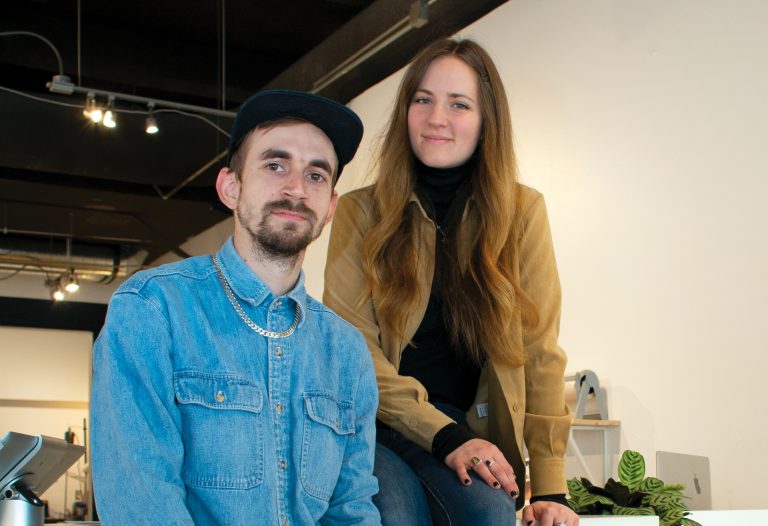
Four budding Bellingham entrepreneurs with new ventures they started in the last two years attended Western Washington University at the same time, but didn’t know it. Jarod Faw AND Hayley Boyd (above), Nick Meza, and Dylan Green met after becoming business owners, and since they have become good friends who’ve collaborated on ideas and products.

In email and telephone interviews, the start-up foursome offered their contributions to a Small-Business Survival Guide. Their thoughts ranged in extremes—from exercising boldness and derring-do (“just pull the dang trigger!”), to a more cautious pause-assess-proceed approach. And they all agree that a good designer is perhaps the most valuable item in the Guide.

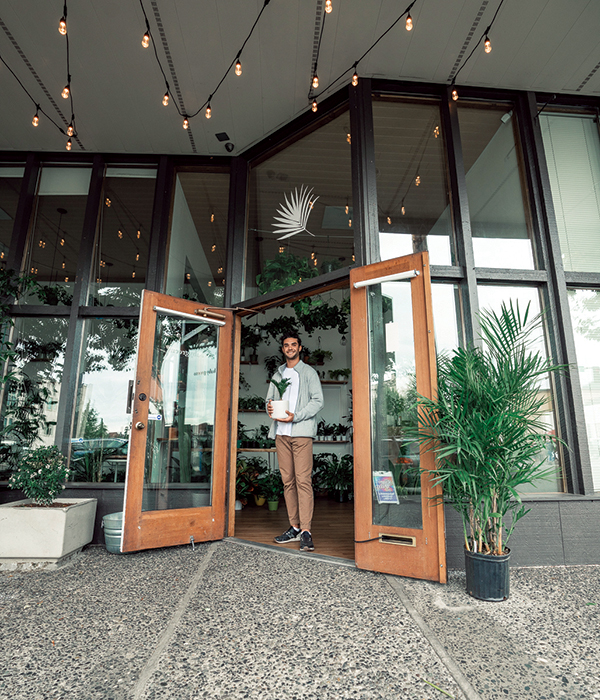
This WWU pride of young lions is as green in business as the plants in Nick Meza’s shop, Babygreens, which he opened in April this year on Cornwall Avenue. Hayley Boyd and Jarod Faw, wife and husband, started Apse in November 2015 while still in art school, featuring their hand-crafted jewelry and art. They opened a studio and retail shop in November 2017, also on Cornwall.

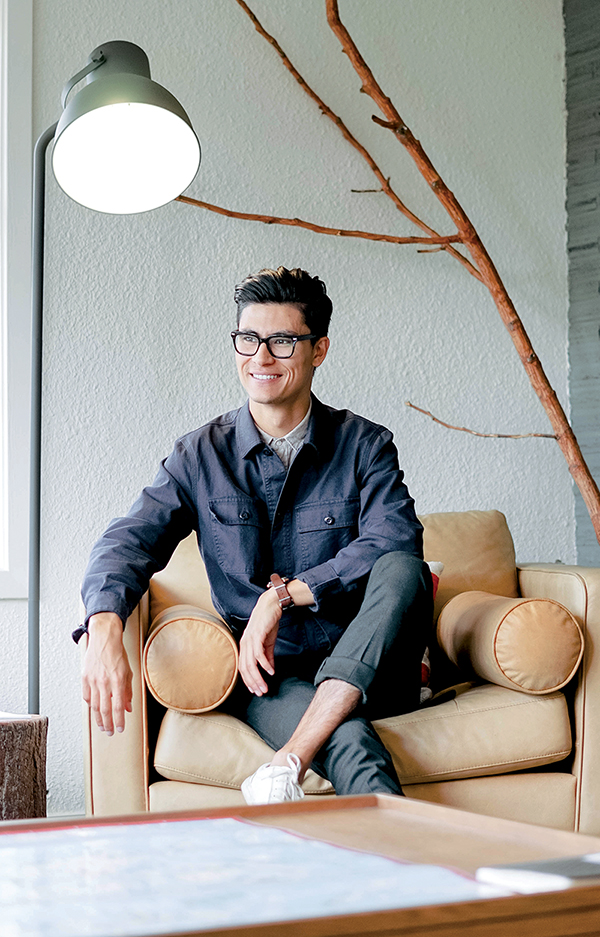
Dylan Green joined a partnership in May 2017 that overhauled the former Lion’s Inn Motel on Elm Street, built in the 1950s about a mile from the center of downtown. As project manager and marketing director, Green linked with renowned downtown developers Bob Hall and David Johnston and the design firm of Smith & Vallee in Edison to open the self-described “boutique” 17-room Heliotrope Hotel.

“You’ve got to look good. Brand ID and development is essential. Make that investment early.”

Dylan Green, Owner, Heliotrope Hotel

Hayley and Jarod met Dylan when he worked for the Downtown Bellingham Partnership and Johnston. “We participated in a couple of Commercial Street Night Markets where Dylan was working, and he loved the wood bolo ties we created. He’s been a massive supporter and even modeled for us.”

Nick joined this friendship and support circle when he dropped into Apse shortly before opening Babygreens. “We’ve stayed in touch through various events and plant adventures,” Hayley said. “Now we have all (four) collaborated on a couple of products in our Bellingham line.”

This feel-good narrative feeds into the No. 1 item Hayley and Jarod would have in the Survival Guide. “A community of innovators,” they stated in an email questionnaire. “Good feedback, peers who will represent and support you, and inspirational people are all priceless and vital for staying relevant and excellent. Without a support system of creatives, it can be hard to know when or what to upgrade or change, and difficult to see your operation from your audience’s perspective.” And they ended with an invitation: “If you’re isolated or lacking community, come say hey.”

Each of the four shared “survival” thoughts about starting a business, based on what they’ve experienced early-on. Excerpts from their input:

Meza started up from personal savings out of a “passion for plants… and a strong appreciation for their cultural value. A straightforward indoor plant shop in Bellingham made sense because the town didn’t have one—at least not one quite like the shop I envisioned (as) the perfect small business to start, and a totally manageable one, too.”

“Accept the risks and just pull the dang trigger!” Proper, and critical planning is crucial, of course, but just dive into things. Be aggressive and stay excited.”

Nick Meza, Owner, babygreens 

He cited boldness as a key to a successful startup. “Accept the risks and just pull the dang trigger!” he said. “Critical planning is crucial, of course, but I think there’s a point where you just need to dive into things. This pressure forces you to take the action you need to take. If you have an idea you believe in, be aggressive and stay excited.”

And what would he place in the Survival Guide? “A design consultant to help get you started in the right direction. A big part of our early success has stemmed from our interior design and branding. People appreciate intentional details,” Nick said. He also mentioned “hiring trustworthy, genuine staff to constantly demonstrate company values. For our plant shop, these values are warmth, kindness, and top-notch customer service.” 

Green at the Heliotrope seconded Meza’s notion. Dylan’s work during the three years since earning a degree in journalism/PR at Western (aside from writing music and touring with bands) has primarily centered on “design, branding, and marketing…that’s how I earned my equity as a partner.”

He was strong on the point of design. “You’ve got to look good. Brand ID and development is essential. Make that investment early. And holistically. You can’t just slap up an image or a logo. Look good online and when they walk through the door. A customer must know what your product and services are, so set your guidelines on what your brand represents and what you want it to do for your business. Keep your vision in the forefront, stay on track and avoid distractions. Otherwise, a customer doesn’t know who you are or what to do.”

Hayley and Jarod have grown from scratch. “We’ve rolled with the punches and put everything we’ve made back into the business,” Hayley said. “We stepped out into the community and invested time and energy into quality products and customer service.”

Where boldness surfaced in comments from Meza and Green, the Apse team suggested, “Don’t be afraid to hit the brake pedal a little bit. It doesn’t mean you are failing (or) messing up. Sometimes it’s crucial to pause, reevaluate, and take a counterintuitive action. In the long run, it could mean the difference between burning out and going for the long haul.” 

Surviving to Maturity: No Small Feat for This Pair of Local Entrepreneurs

0

Kevin Buck in Bellingham and Tim Lukens in Custer represent the mature stages of owning a business, lasting 32-plus and nearly 20 years, respectively, and still counting. They’ve succeeded with similar approaches to products, services, and customers—but with vastly different models.

From their experiences, they offered some solid contributions to our Survival Guide for Small Business. In a nutshell, they demonstrated vision, perseverance, and adaptability to changing markets—both men developing from humble beginnings.

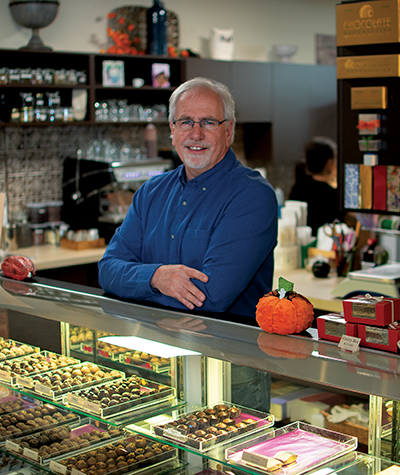
Buck has retailed and wholesaled with Chocolate Necessities in the same location, in a business park off the Guide Meridian intersection at Horton Road, since 1986. He opened a downtown shop in 2005, adding Italian ice cream and beverages to the core chocolate products. “I’ve always had just one objective,” he said, stating that the company has grown steadily year-over-year on a simple, small-scale model, driven by using the highest-quality ingredients available anywhere in the world.

Kevin started his company on savings from several years of work in the maintenance department of Ferndale School District, renting the space and making chocolate truffles on a small scale until he built a strong enough customer base to open to the public.

Lukens grew up on a dairy farm and, after many entrepreneurial ventures and jobs at Alcoa Intalco Works, he and his family bought Grace Harbor Farms on Lynden Birch Bay Road in 1999. Their business has been chameleonic—changing products and markets and even entirely converting their operating model in 2017 from dairy production to processing, distribution, and retail (both in a farm store and online).

“We started with two goats,” Tim said, with the purpose of producing milk and other dairy products at home, when the Y2K technology collapse became a dominant theme entering the millennium. Tim’s wife soon learned to make soap and skin and healthcare products from goat’s milk, and that took them in another direction entirely.

Since then, Grace Harbor Farms has evolved many times over. It subsists on the wide-scale distribution of dairy products, working with producers at three other farms, and a long line of natural-ingredient soaps, creams, and lotions that dominate the home page of their website.

Each of these business owners has long and fascinating stories to tell, which could fill volumes, but here they share what they feel were their keys to surviving in business for the long term:

KEVIN BUCK

“You must have a clear vision. From day-one, ours has been to offer high-quality products at an affordable price. You must never compromise your service or product, no matter the cost—and it was costly at times, no question—because we’re in it for more than the money. I also knew what I wanted to become and remain—a small-scale business with big results, not a big, bold corporation.”

“Then you identify what I call the enemies of your vision. To make more money, do we want to make fudge? No. Conventional thinking is ‘listen to the customer’. That would have killed us, because I’d have turned into a candy shop. We ran counter to what would have been the Survival Guide back in 1986.”

TIM LUKENS

“You have to be willing to go through the learning curve and stay with it. It can take a long, long time. I didn’t take a dime for about 10 years, we crashed hard a time or two, and we refinanced our mortgage to keep going. But I’ve been self-employed, basically, since I was 18 and I get excited about what the marketplace does and consumerism. Now we have good brand recognition of Grace Harbor International (natural products), good margins, and great relationships (with partnering farms).”

“By the Good Lord’s providence, we’ve held on by our fingernails through difficult times and changes. We’re excited now after redefining ourselves as a boutique operation and working directly with other producing dairies to process and distribute. (Grace Harbor wholesales product to more than two dozen outlets throughout the Seattle, Puget Sound, and Whatcom County regions.) If you compared us to the local breweries, we’d be called a micro-dairy processor. And I’m pretty much a CFO these days.”

Case of Lynden Organic Dairy Farm Spurs Concerns

0

Hans Wolfisberg grew up in Switzerland, but when he came to Whatcom County in 1996 he felt he had found a true home. He purchased a dairy farm just outside of Lynden, with 60 acres of land right on the Nooksack River. There he began Edelweiss Dairy, an organic dairy with about 150 doe-eyed Jersey cows.

Organic dairy farmers must graze their cows on grass during the Summer months. To maintain enough grass for his cows in those dry months, Hans irrigated his fields. The water came from a well, with what might be called “provisional” water right under a long-standing application on file.

Enter the Department of Ecology (DOE), the state agency charged with managing water rights. From the early 1970s forward, Ecology staff has allowed farmers use of well water for irrigation, with the promise that a fully legal water right would be provided later. Years later, many farmers still are waiting for DOE to fulfill that promise. And today, as water rights are increasingly in political crossfire, farmers like Wolfisberg have grown more and more concerned.

While Hans was irrigating last year, an unofficial “inspector” cruised down the Nooksack River looking for potential water-rights violators. The “inspector” incorrectly (according to records on file) reported to the State that Hans was illegally withdrawing water from the river. Hans reassured the Ecology staff, who subsequently visited him about that report, that he did not draw from the river; rather, he pointed out, he only used his well, as he always had since he bought the property 22 years earlier. This year, Hans received notice that he did not have a legal water right and that he was to stop irrigating from his well immediately.

This was devastating news. He not only had to buy expensive hay to feed his cows, he stood to lose his organic certification. Without grass, his cows couldn’t graze.

Farmers appreciate Ecology’s constructive work with farmers on these issues. But this action shows that political and legal pressure on Ecology appears to be mounting, with potentially disastrous results. Despite claims by a few activists who say we have a water crisis, our aquifer in Whatcom County is filled to overflowing every year.

We farmers now understand that if the water in the river or streams gets too low, it can harm fish through increased temperature or interference with spawning. Farm leaders have been working with Ecology, and tribal leaders, and others for the last 25 years to address water issues constructively, with positive gains. And many farmers have converted their initial rights to draw from the Nooksack and streams into groundwater rights.

This has been made more difficult by ill-considered court decisions such, as Foster vs. Ecology. Lacking scientific justification and contrary to Ecology’s position, the Washington Supreme Court declared that removing even one molecule of water from the ground is the same as removing it from the stream or river. This means even groundwater use can run afoul of Ecology’s imposed in-stream flow rules.

The power politics of water rang clearly in the Hirst decision, prompted by the antigrowth activism of FutureWise. Without adequate scientific basis, the Washington Supreme Court allowed no further withdrawals from our massive aquifer without verification that a well would not harm fish habitat in any way.

In the last legislative session, aggressive lobbying successfully secured sizeable funding, with directions to DOE to enforce existing water rights. Even if this action is not directly aimed at farmers, the unintended consequences raise considerable concerns.

What happened to Hans Wolfisberg could become a common and devastating story for farmers in Whatcom County and beyond.

Marty Maberry, co-owner of Maberry Packing in Lynden, is a long-time farm leader who has been directly involved in resolving water issues since 1993.

State Colleges and Graduates’ Comparative Starting Salaries

0

Because college students are taking on more debt than ever, a key factor in a student’s decision to attend a college is the starting salary they can expect after graduation. However, the cost to attend an institution of higher learning increased nearly eight times faster than wages did. to wit:

The average annual growth rate for the cost to attend a four-year university between the years 1989 and 2016 was 2.6%, compared with only a 0.3% annual growth in wages.

This leaves many students considering which colleges will provide them with the best starting salary upon graduation. A recent study by SmartAsset ranked the schools where students earned the best average starting salaries in Washington state.

Surprisingly, the top 10 all fell within the $50,000 range, with a high of $57,300 for the University of Washington Seattle Campus and a low of $50,000 for Pacific Lutheran University and Whitman College. Western Washington University was No. 7 at $50,600.

In other considerations surveyed:

The student-retention rates ranged from a high of 94% at UW/Seattle and Whitman to a low of 82% at WWU.

Both Whitman and PLU led in average scholarship and grants available at $25,600.

Whitman and PLU also were substantially higher than the other colleges in annual tuition at $46,138 and $44,976, respectively.

Annual student living costs ranged from a low $13,506 at PLU to a high of $16,791 at Seattle University.

Additional information can be found at smartasset.com/student-loans/student-loan-calculator#washington/salary.

Viva Italia… in Sumas?!

They gathered for interviews, five kart drivers.

One, Oliver Carpentier, stood about tire-high to a racing kart. He’s 4. He’s still learning. His brother, Levi, already races karts at age 8. Their uncle Michael has retired from Formula sports car endurance racing (think of 24 Hours of Daytona or LeMans) because of an injury. His son, Massimo, is filling Michael’s vacuum—at age 10!

Their grandfather, Claudio Valiante, began this family racing strain after he moved from Italy to British Columbia in 1965 and started racing vintage Fiats. These three generations of race car driving have all come to a zenith in Sumas, where they train, race, or work. The Valiante clan now operates Sumas International Motorsport Academy (SIMA) in northeast Whatcom County, sitting on 15 acres hard by the Canadian province where kart racing has long been a rage.

Claudio’s daughter, Claudia Carpentier (and Oliver and Levi’s mother), is  General Manager of SIMA. And Claudio’s wife, Beverly Valiante, takes care of the grandchildren. “Obviously, we’re a tight-knit family,” Claudia said. “And everything we do here revolves around treating our customers like they’re ‘family,’ too.”

Everything at SIMA operates under the umbrella of Italian Motors USA: one big pit stop, so to speak, incorporating everything associated with kart racing.

Subsidiary divisions outfit a kart driver completely, from head-to-toe with specialized helmets, racing suits, and the company’s own brand of imported racers (ItalKart). The Valiantes design the engines and chassis and have them manufactured in Italy and stocked in the Sumas warehouse. SIMA is one of the largest kart sources in North America, through online sales and shipping anywhere on the continent.

And SIMA is for everyone, female or male, any age. The experience holds appeal for a family outing or a company team-building retreat. All the necessary equipment is for rent, along with the karts and time on the 17 curves of the three-quarter-mile track, the only artificial turf track oval in this region.

Then there’s the learning phase. SIMA stages a driving academy, starting at pretty much any age; some families have two-year-olds driving karts. (Children must be seven and certified before they can enter races.) Kart owners can rent garage storage space, and the maintenance and parts departments will keep their karts shipshape.

And the cost? “It’s the least-expensive form of motorsports racing,” Claudia said. The basics consist of a helmet, around $200 for a starter, and a starter kart around $3,000. However, helmets can range up to $1,000 or more and karts up to as much as $12,000, depending on the degree of customization, according to Claudia. “For instance, take tires—on other race cars they run $5,000 or more for a set of four, and ours are $250 for four. You can put together a basic recreational race-wear package for probably $600. It’s expensive, compared with other recreational sports, like skiing,” she said.

SIMA creates marketing packages for birthday celebrations, family reunions, bachelor parties, and corporate outings. One package is a Mini Grand Prix that includes race instructions, a 10-minute practice session, a 12-minute race, and a podium ceremony—all for $450 for 10 people (and $45 for each additional person). For $600, a group gets a heat race before the final race.

The patriarch, Claudio, is 72 and still going strong. He’s at the track daily, tinkering with engines and kart design, helping with construction, or whatever is needed. For the interview, he took a seat in the café on the premises (not just a burger and snack bar, but a full-menu café where he’s the chef on race weekends, producing full-blown Italian dinners) and he spoke of how this all came about.

“I came from Salerno to live with my sister in B.C. when I was 18,” he said. “Ever since I was 10 or 12, I loved working on anything that had an engine in it.” He came from a family of seven children; father was a carpenter, and mother an entrepreneur.

Once settled in B.C., he took a job at a company where “we built school-classroom chairs,” he said. At the same time, he became a machinist in a little shop at home and began racing in vintage cars—mostly Fiats—building his own engines and bringing home a slew of trophies and prize money. But when he married Beverly, they opened a European auto repair shop. From their savings, Claudio and Beverly began buying land in upper Whatcom County, with dreams of building a kart track.

Their interest in karts grew from a track that operated up the hill from their home in B.C. Michael became one of the top kart racers in North America before switching to Prototype endurance driving. He drove for about 25 years on contract with the Atlantic Lynx Racing Team. A few years ago, during a race, the brakes on a car behind him failed and the car rear-ended Michael, who already had been slowed by previous concussions. Injuries from that crash ended his driving career and he now oversees driver development at SIMA. He also helps design and calibrate engines on a $100,000 computerized Dyno-Test machine.

Claudia Carpentier never raced, but she went to Douglas College in New Westminster, B.C., and earned a degree in recreational therapy. The family’s specialty car-repair shop eventually transformed into a full-service kart shop, and the family passion for the sport grew. “We first tried to build a track in Bellingham, on the I-5 corridor,” Claudio said. “But too many people didn’t want it. They said too much noise, and the rabbits couldn’t survive, that kind of thing. So, after two years of trying, we purchased the land in Sumas.”

It proved to be a blessing for neighbors to the north. Canadians now cross the border at Sumas for more than gas and milk. They flock down to race karts. Celebrating its eighth anniversary this July with the SIMA Gold Cup, the weekend of kart racing drew 256 drivers from both sides of the border and hundreds more spectators and crew members.

With British Columbia’s Lower Mainland already intensively developed, Claudio has discovered that the west edge of Sumas, just a couple miles south of Abbotsford and the Trans-Canada Highway (Hwy 1), places SIMA well within an hour of karting enthusiasts in Vancouver and its suburbs, plus the untapped market of Bellingham and Whatcom County.

What lies ahead for Claudio & Co.? “My vision is to improve our existing track, eventually build a longer track and erect a grandstand. It’s hard to make this kind of investment and earn it back, but I can’t stop dreaming.”

Bellingham 5th Worst Job Market in the U.S.

0

…And Washington, Bottom Five in Small-Biz Friendliness

An online organization called Zippia.com, specializing in resources for searching the job market for golden opportunities, listed Bellingham as the 5th Worst Job Market in the U.S. for 2018. The criteria for determining the rankings, among 386 metro job markets in the U.S., included wage fluctuation, current unemployment, and the rate of rise or decrease in unemployment. The study scored each category best-to-worst, 1–386, and then ranked cities on the average of the three scores.

One other Washington city, Wenatchee, and four more West Coast cities ranked among the Worst 10—Grant’s Pass, Oregon, and three in California. Others in the Worst 10 are in West Virginia, New Jersey, and Maryland. These areas have the bleakest employment outlook in the country, according to  Zippia, which stated, “If you’re a new grad looking for work or in mid-career searching for a change, you’re not going to find what you’re looking for in these places.”

For Bellingham, the survey cited 4.8% unemployment among an employed population of 85,600, with an average annual income of $48,030. “Bellingham was (formerly) a force to be reckoned with…a major industrial player,” Zippia said. “Now the area isn’t exactly a hotspot for people looking for work.”

Zippia.com conducted a similar survey to rank the best job markets in the nation, and no metro area in Washington made the list. On another front, a respected research website, ValuePenguin.com, ranked states on Small-Business Friendliness. Washington ranked No. 47. That survey used criteria from data at the U.S. Census Bureau and the Small Business Administration to identify where small business, the lead researcher said, “…will succeed or not.” P+

Q+A with Kevin DeVries

0

Exxel Pacific employees (left to right in the photo): Adam Bravo, Brian Proctor, Mike Shafer overseeing construction of the new Bellwether Apartments

Kevin DeVries has Passion for Curating Positivity in the Exxel Pacific Workforce

Growing up among seven children on a farm near Pella, Iowa (pop. about 10,400), Kevin DeVries developed a sense of “family, hard work, and respect for others.” He applies those core values in hiring at Exxel Pacific, the company he leads with 240 employees. He attended Dordt College on a “crazy little leadership scholarship,” majoring in psychology, and after graduation in 1986 he came to Bellingham to visit a classmate. And stayed. He co-founded Exxel with Sid Baron 30 years ago. Creating a positive, caring work environment “is what gets me excited in the morning to go to work,” he said, crediting his Christian upbringing for his approach to “hiring the best possible people you can find, and all have a common goal—wanting to be the best. It drives us.”

What drives you in staffing Exxel Pacific?

Our leadership is very passionate about what it takes to run a company and make it very successful. Truly and simply, it’s your people. We stay focused on having the right people and helping them become the best they can be.

What do you look for in an employee?

What kind of messages do they convey? Will they contribute in a way that builds up people around them and encourages everyone to be the best they can be? We look for passion in what they do—that this is something more than just a job to them. When they’ve bought into our goals as a company then compensation and benefits are less of a factor than those who want to talk about salary before they even know what “the job” is.

How do you approach the labor market?

The depleted labor pool continues to be a big issue. Exxel Pacific works very hard to provide a high-quality place to work. Our success in adding people to our organization is a tribute to the people we have. It’s important to identify people who enjoy and contribute to the teamwork and camaraderie. We also seek people who sustain a balanced work environment. A key factor is whether we have something to offer that is perceived as extra special and that other companies don’t have.

What’s at the heart of your hiring?

From the beginning, our focus has been on highly skilled professionals who also are good people who have strong character. People do business with people; and if they don’t like you, they won’t work with you.

What’s the hiring process?

We do a lot of peer hiring. Respect and trust from peer workers is a big thing. Everyone needs to earn that respect of others in their roles in the company. We’ll put prospects into multiple positions, let them meet our people, get a flavor of what our people say—and vice versa. We don’t really have a sales pitch for new people, just our workplace culture that we think is special. We are not perfect, but every one of our leaders and managers believes that what we do is the right thing—even when it might cost money to do so.

Name a favorite characteristic you look for.

People who take ownership of their position, which goes to the base integrity of the individual. If they had to write the check themselves, would they make the same decision to do it? Would they say, “I screwed up, and it’s going to cost us some money,” or do they immediately try to deflect the problem to somebody else?

What’s the greatest factor in managing staff?

Mutual respect. How we treat each other is absolutely at the top of our list. If you are not respected as a leader, then you won’t have many people follow you. As managers, we are only as good as those around us to support our efforts. It is a two-way street.

How has the employee pool changed?

With younger people coming into the construction industry it’s a new day. The workforce is much different; job change and transition is a positive. That goes against the old approach of having employees for 20 years. This generation looks for constant feedback in their roles, and their compensation and benefits are more immediate concerns. As leaders, we try to look at their point of view, which is very hard to do sometimes, but management also needs to adapt. As a construction company, you still need people who know how to build the project and do the work.

How do you deal with that?

We spend much more on training people in the ways we feel can be successful for all parties. It’s expensive, but we work hard to get new hires who want to stay a long time. We believe that our new Employee-Owned concept helps, although base salary still has a tendency to be very important because that’s usually what’s discussed with their peers in the industry.

Do you need a college in your business?

We have a lot of people with construction-management degrees, but we also have a number with no college education. We want to know who you are, not what major you have. These days you hear, “I don’t want to go college, don’t want to spend the money, don’t know what I want to do.” We encourage attending college. We have a number of fantastic people (without degrees) who work very hard and are very proud of what they do. We all need each other in this business and it takes a wide variety of people to make a company successful.

What criteria carry the most weight in your hiring?

We make sure we hire people who are grounded in their communities, who give back, and who believe in something more than just going to work on a job. I’ve truly enjoyed working with young people who don’t expect a handout and who work because they enjoy it. If you give them the tools to succeed, they’ll exceed your expectations.

Do you have time clocks?

No. We never have had them. If we have to worry about whether an individual is putting in their time, we probably shouldn’t have hired them and they will eventually work themselves out of the company.

Do you have titles?

We do, and I think more emphasis has been placed on titles than necessary. Titles are only as good as your leadership characteristics. If you are respected as a leader, you can have any title you want. If you are not respected as a leader, a title won’t make a difference. People need to trust us as leaders in the same way we need to trust them to do their work—a way that meets our goals for the project and client.

What’s the future for Exxel?

It takes a lot of capital to operate a construction company. Our partners have found that the best future for the company is to walk the talk and always do the right thing for the people we work for and with. We put our faith and trust in our people. We decided to go to employee-owned last December. We believe that employee ownership goes to the base of our culture and can provide for the long-term sustainability of our workforce.

Sum up Exxel Pacific as a workplace of choice.

Numbers and longevity speak well for us. We have a few hundred employees, and many have been with us for a long time—up to 25 years or more. When someone new wants to come on board I hope they hear from our work family that this is a great company to work for, with great benefits, that’ll provide everything needed to get the job done, that the company and leadership care for you as an individual.

And that we like to have fun and no drama.