Home Blog Page 26

JCPenny Building: Dead Or Alive?

[This compilation was gleaned from Whatcom Superior Court minutes, Bellingham City Council minutes, news releases, off-the-record conversations, and various media reports, especially an article by reporter John Stark in Cascadia Weekly.]

During the Summer of 2018, for our regular Business Pulse Q&A feature, Jeff Kochman and Jeff McClure discussed their offer to purchase that iconic but 30-years-vacant JCPenney Building and their plan to double it to four stories high and develop it for mixed-use offices, retail, apartments, and parking.

The interview didn’t appear as planned in the Sept.-Oct. issue. Nor in Nov.-Dec. Nor in Jan.-Feb. Nor now—eight months later. Complications have compounded, and confounded the principle players. The deal remains stagnant, and the building stands vacant, as it has since 1988.

Numerous delays have resulted from—well, put it this way—if you can follow all the characters and the plotline, you probably liked Tolstoy’s War and Peace…

Sept. 2018: Kochman and McClure proferred $712,000 for the building and a commitment of $12 million to expand and renovate it. They’d arranged the deal with Bruce Tolchin, who lived in California and controlled Whatcom Center LLC, which bought the building in 1998.

Sept. 26: Doug Tolchin, Bruce’s brother, surreptitiously created an LLC titled “1308-1320 Cornwall.” Doug and his mother, Mary, and an associate previously managed Whatcom Center LLC’s business, until legally assigning control back to Bruce in 2010.

Oct. 8: Bellingham City Council approved a public-private partnership with the Kochman-McClure team. The City committed $2.1 million to buy the land that the building sits on, with the caveat that the developers would lease it. A closing date was set for November.

Same Day: Doug Tolchin moved the building and property from one holding company to another. He notified the City and the developers that Whatcom Center LLC didn’t have the rights to sell and threatened to sue if the sale took place.

Nov. 2: Bruce Tolkin countered with a lawsuit against his brother, claiming full authority to sell.

Nov. 19: Bruce Tolkin died. He had signed a document that day moving the closing date of the sale to Feb. 1. The case was frozen. His $50 million estate trust manager sought to oversee the case.

Soon after: Mary Tolchin sued to stop the trust manager in California.

Feb. 8: Whatcom County Superior Court Judge Robert Olson ruled no, temporarily, on an extension to close the sale, yet Judge Olson scheduled two more hearings here in early March on who has rights to what.

Meanwhile, the developers and the City confirmed to Business Pulse that they’re still on board.

Business Succession Planning Smooths the Path of Ownership Transition

“Broad and deep preparation, both mental and emotional, is necessary for successful leadership. It’s important to mentor a possible successor to share your passion for the business….(and) use a team of succession experts to make a difference.”

Exiting the business is something most entrepreneurs don’t think about. Yet, having a succession plan is essential for anyone who ultimately wants to realize the full value of their business. Without a formal succession or transition plan, a closely held business risks not only its longevity, but also its bottom line.

While 80-90% of businesses in the U.S. are family-owned, fewer than one-third succeed into the second generation—and just 10 percent survive into the third.

Why succession planning?

Few events in the life of a small business are as critical, visible, or stressful as when its owner leaves. The eyes of every employee, customer, supplier, and stakeholder focus on the outgoing leader and the preparations that ensure that the company succeeds without him or her. Family-owned and closely held business owners often never take the necessary steps toward a smooth transition in leadership.

Typically, they don’t clearly identify a successor, or they failed to prepare their company to succeed without them.

One way to greatly improve the successful sale of a business is to strengthen it from the foundation up, focusing not only on the technical details of the business but also on the people and processes that can help maximize its value. To ensure that the interests of your selected stakeholders align with your business, and to make certain you have the right people supporting your efforts, consider the following questions:

Which of your key employees have the ownership mentality to take your business to the next level? Simply because someone has been second in command, or is related to the family, doesn’t mean he or she is necessarily the best choice to succeed you. The right person is often the type you may have avoided hiring in the past—an entrepreneurial leader just like yourself.

What steps are you taking to mentor a possible successor?  Broad and deep preparation, both mental and emotional, is necessary for successful leadership. It’s important to mentor a possible successor to share your passion for the business.

Do you have a plan for a pool of talent in key areas of your business?  Potential buyers often look beyond the spreadsheets to the quality of the employees behind the numbers. It pays to have some simple processes and procedures for evaluating the performance of employees and identifying where potential gaps exist for placing future talent.

How will you reward these select employees? If there are people you’d like to take care of in the transition, such as certain non-owner employees who helped make the business successful, be careful that this desire doesn’t conflict with the economics of getting the deal done with the buyer. An incentive-based compensation program tied to company performance can sweeten a transition plan by fairly compensating employees whose contributions impact the most, and by encouraging them to remain after the transition.

Don’t go it alone!

You spent a lifetime successfully driving your business forward. Selling or otherwise transferring that business can be one of the most challenging tasks you face. Use a team of succession experts to make a difference.

At minimum, work with legal, accounting, and other financial professionals experienced in the field of succession planning who can help with a seamless, productive, and unifying transition. Advisors can help you assess your own strengths and weaknesses, so that when the time comes you’ll be well-positioned to transition your business on your terms—when you want, and how you want.

How To Run a Small Business Without Running Yourself Into the Ground

Patti Rowlson with daughter Kelsey.

A study of the U.S. workforce, released by internationally recognized FreshBooks at the end of 2018, projects that by 2020 some 27 million Americans could leave traditional work in favor of full-time self-employment, joining the 15 million already there.

The study found that, in the minds of American workers, the drive to climb the corporate ladder has been replaced with the desire to control their own careers, to have flexible schedules, and to choose the type of work they want to do. Those desires certainly can be achievable in the life of an entrepreneur.

FreshBooks reported that all of these newly independent, self-employed workers expect to have less stress, to improve their work-life balance, and to be in better health.

Wait. What?

Reading those expectations gave me pause, because I’m not so sure many self-employed people would concur. Actually, a few I spoke with about this chuckled when I asked if entrepreneurship brought them less stress, more work-life balance, and better health than traditional employment.

Maintaining health and wellness while being self-employed takes effort!

Self-employed myself, consulting alongside local business leaders and entrepreneurs since 2009, I’ve seen that those three expectations can be quite difficult for entrepreneurs. The reality is that it can be stressful to generate enough work to pay the bills. Not to mention managing people, staying on top of taxes, making sure business-development and growth plans stay on track, keeping up with marketing—all challenging parts of entrepreneurship.

Self-employed individuals also can have trouble disconnecting from work. They work long hours and sometimes put their own health and wellness on the back burner. Been there, done that myself! For many, successful self-employment takes a continuous effort to manage work-life balance, stress levels, and our own health, because business matters often take priority over any or all of those ideals.

So, how can self-employed people run a business without running themselves into the ground? One answer is to make time to step outside, away from work. That’s my story in a personal journey and lifestyle changes made throughout 2018.

Hmmm. How can spending time outside help entrepreneurs manage stress and improve their health and wellness? It has to do with something called brain-life balance.

Entrepreneurs need ‘brain-life’ balance

In a Psychology Today article (posted online Jan. 19, 2016) psychotherapist Jade Barclay shared findings she uncovered in writing her MBA thesis, namely: “We don’t need work-life balance, particularly entrepreneurs. We love our work. Work is life. We need brain-life balance. We need the way we’re managing our time, and the way we manage our communication with ourselves and others, to actually be friendly to our brain and our body.”

I believe her insight. The self-employed people I know (myself included!) love their work. It fuels them and provides a high level of job satisfaction. I also know that self-employed people push themselves too hard and that they’re their own worst critics, which can lead to added stress and even burnout. Barclay explains in the article that stepping away from our work environment—just a little each day—is very important. That goes a long way toward reducing stress and preventing entrepreneurial burnout.

A challenge begins

I experienced and felt the benefits of connecting with nature when I began to re-balance my own health and wellness in January of 2018. I began a 365-day personal challenge that included time outside every day—rain or shine, wind, or freezing temps. The goal was intentionally moving in the fresh air for at least one mile each day, either walking or interval jogging. My mantra: I can endure one mile, even in the worst conditions. No excuses.

The 365-day challenge was healthy for me in a number of ways. It started off as just a reason to step away from work to reset my brain and shake off any tension that had built up during the day. That worked! A mere 20 minutes on the trail helped me feel refreshed and refocused. That felt great, so I kept going every day for an entire year.

I didn’t miss one day.

I participated in charity walk/run events. I completed a 10K. I went on six-mile hikes. I met business peers for a walk instead of coffee. PR Consulting—my company—hosted meetups that included networking time on the trail. I spent a ton of quality time with friends and family on the trail.

Pretty much everyone I know can walk a mile, too, and they were willing to support me in my challenge. I learned that I could inspire others to spend time in nature, and they enjoyed it, too. I also had a lot of solo time on the trail, which gave me space for thinking and planning. Sometimes I’d listen to leadership podcasts. Sometimes I’d listen to really loud music, so I didn’t have to think about anything at all. I called those my cheap therapy days. Ha!

Two lessons learned on the trail

As the weeks and months rolled by, I learned that I had grit and determination, and that I knew how to set goals and to compete with myself, instead of comparing what I was doing with others. This challenge, and the time I spent in nature, taught me that I didn’t give up on things that were hard and outside of my comfort zone.

Guess what? Those qualities are also important for self-employed people.

I also realized along the way that keeping myself healthy and well is a good business practice. I know that many people depend on my work, and I don’t want to let them down by being sick. That insight motivated me.

Better brain-life balance achieved!

Over the course of the year, through daily efforts, I realized that a shift had occurred. I had planned my days around trail time, instead of the other way around. I could feel that I was on a path (literally) to improved wellness and a better brain-life balance. It seems that the experts who recommend connecting with nature as a way for entrepreneurs to reduce stress and improve wellness are right.

That 365-day wellness challenge changed me in ways I didn’t dream of when I took those initial steps in January 2018.  I didn’t realize at the time that I was working my way toward better brain-life balance. I’d thought I just needed a bit more exercise and to get away from work a little more.

With my feet on the trail, placing myself in nature each day, I’ve changed. I now go to yoga classes two to three times a week for grounding and for a chance to really disconnect from technology. I learned about mindfulness and I practice being present in each moment.  I set personal-growth intentions. And I eat healthier.

On January 1 of this new year, I began a new 365-day challenge.

One thing we entrepreneurs learn quickly is that we’re never done learning, never done growing. Every day brings more challenges to our old ways of thinking and more opportunities to challenge ourselves. Better brain-life balance in the past year has led to changes I hadn’t expected, and I’m genuinely excited to discover how my relationships with work and life continue to grow in 2019.

Onward I go.

Patti Rowlson launched PR Consulting in 2009. Her small business helps Whatcom County companies, large and small, manage their marketing efforts, including communications, branding, public relations, copywriting, website tech support, and recruitment advertising. She serves on the Board of Directors of the Whatcom Business Alliance. https://pattirowlson.com/

Video Marketing: Easy, Effective, and On-the-Rise

Video marketing is one of the most effective ways to promote your business or organization. According to the State of Video Marketing 2018 report by Wizowl, 97% of marketers say video helped increase consumers’ understanding of their product or service, and 76% said it increased sales.

Beyond this, about one-third of all content consumed online today is video and about 72% of consumers prefer to learn about products and services through video rather than text. Most marketers know that “Content is King”—and now, more than ever, the content most likely to engage your customers is video.

Lucky for you, you don’t need a professional videographer or expensive equipment to make effective videos—a simple smartphone and free editing apps will do. A couple of months ago, to promote a music-streaming service, I corralled a few coworkers into creating a short action video montage of their feet dancing. I pieced the video clips together in a free video-editing app, added some open-source music, and voilà—our company’s new Facebook video ad (which only took about one hour to film and edit) received about twice as much engagement as our previously static verbal-and-image ad.

Here are a few ways you can easily promote your business with videos:

Facebook Live: Facebook videos receive about eight billion views a day and get significantly more social engagement than YouTube, according to AdEspresso—a Facebook ad-testing platform. Facebook Live, introduced in 2016, allows you to broadcast and interact with your customers in real-time, garnering instant comments, likes, and questions. Facebook’s algorithm also favors live broadcasts, giving you a nice boost in your customer’s News Feeds.

To start, host an “ask-me-anything” broadcast where customers can ask your team and/or owner questions in real-time, broadcast a cool company event—like a product launch, volunteer event, conference, home showing, etc. Or share a behind-the-scenes look at your company or operations.

Instagram: Instagram’s one billion users watch 60% more video on the platform than they did one year ago, according to Fast Company. In 2016, Instagram increased its 15-second video limit to 60 seconds. And in September 2018, to capitalize on the rise of video marketing, they launched Instagram TV (IGTV), which allows users to upload long-form, vertical videos as long as 60 minutes. Use Instagram videos to tease new products, share short tutorials, and offer candid team interviews.

A few tips:

Use humor and stickers to humanize your brand. VidMob’s State of Social Video 2018 report found that users prefer funny content.

Instagram videos are muted by default, so make sure there’s movement and/or text within the first few seconds to capture your followers’ attention.

Ask for user-generated content by encouraging your followers to post their own videos with a custom hashtag.

Since Instagram is a mobile platform, shoot your videos vertically so they fill the screen.

If you’d like your video to hit the top of your customers’ feeds (as opposed to being pushed down by Instagram’s algorithm), use Instagram Stories. These 15-second video clips or photos disappear after 24 hours, although you can save your favorites to your profile as a “Story Highlight.” Instagram Stories have become incredibly popular, with about 400 million daily users—up from 300 million, or 33% more than about one year ago, according to Social Media Today.

YouTube: The behemoth of all video marketing platforms, YouTube is less about short, candid updates like Instagram and Snapchat thrive on, and more about long-form videos with a longer shelf-life. YouTube is the second most popular search engine behind Google, so the platform’s one billion users rely increasingly on YouTube to answer questions (how-to, product information, etc.)—making it a great place to establish your product or service as their answer.

Create your YouTube channel to promote webinars, tutorial videos, product videos, interviews, and more. If you don’t have much time to create videos, break down one idea or topic into shorter videos to increase content, which also makes them more easily digestible for viewers.

Similar to Instagram and Facebook, YouTube’s algorithm controls what users see, so ask for likes, comments, and subscribers to boost your ranking.

Professional’s Tip: Get more bang for your buck by embedding or linking to YouTube videos from other marketing channels, such as your website, emails, or blogs.


Video Marketing Tools (mostly free)

Camtasia: This works great for tutorials and how-to videos ($249 for each license)

TechSmith Jing and Capture: TechSmith’s desktop and mobile apps offer easy screen recording (free).

iMovie: This desktop and mobile app helps you edit, animate, and add music to videos (free).

Splice: This mobile app works great for editing audio and video captured on your phone (free).

Ripl: Make professional animated videos from still photos (free for Basic, or $14.99 a month for Pro).

Animaker: Create animated videos from a library of pre-designed clips and graphics ($19-$59 a month).

Dynamic Duos: Father-Son & Lean Six Sigma

Jeff Gray and his son, Mason, moved to Bellingham last year and they have cut a wide swath into their life mission—instructing and guiding business leaders through the internationally acclaimed Lean and Six Sigma training. In addition to the full curriculum they created and teach in Bellingham Technical College’s Continuing Education Program, businesses contract with them through Jeff’s company, SixSigmaTV.Net.

What’s the difference between Lean and Six Sigma

Mason Gray: Lean, in short, is eliminating waste in business.

Jeff Gray: Six Sigma reduces variations and defects.

You merged them. Why?

JG: Combined, they work together to eliminate the costs of poor-quality performance, the things that sink a business.

MG: You can do one without the other, but it makes more sense to add the simplicity of Lean to the reliability of Six Sigma. It’s a happy marriage.

What’s at the core?

JG: Teaching businesses to eliminate where they’re bleeding (wasting resources) and reducing their variabilities so they can innovate and grow. In a nutshell, the keys are to standardize and stabilize, then innovate and grow to the next level of excellence and productivity.

Teach it where?

MG: Courses at Bellingham Technical College (BTC), where I graduated in 2018 from the fisheries and aquaculture science program. We’ve written BTC’s curriculum for Lean Six Sigma and we teach the courses.

What’s the methodology?

MG: With clients, we hold a variety of workshops focusing on waste, variation, innovation, and how to build market share and revenue growth using the DMAIC Lean Six Sigma methodology. [Note: DMAIC is a five-phase process—define, measure, analyze, improve, control.]

JG: We measure KPIs (Key Performance Indicators).We relate projects and issues to KPIs, aimed at growing revenues, eliminating waste by X-percentage, increasing capacity, improving through-puts, and reducing turnover.

Is it all classroom lectures?

MG: No. We also go to the workplaces and work with them hands-on, with support and mentoring on projects, measuring goals and targets, and working to close gaps. We teach the executives to learn and lead as they integrate Lean Six Sigma into their projects. And we ask them to bring in their next leaders, too. And it’s all tied to net savings on the bottom line.

JG: We’re working with numerous clients on-site: Silver Reef Resort, TransOcean Products, Cascadia Eye, Brist Manufacturing, Chevron/Texaco, and SODO Commercial Builders.

What’s that technique you use with a funny name?

MG: You mean the Gemba Walk? It’s a Japanese term that means ‘go to the scene of the crime.’

JG: In English, it’s basically saying to go to where the work is done. See how things are performed. And find out what their ‘crimes’ are.

MG: It’s an assessment tool. We do it the first day with leadership and subject-matter experts to identify areas for optimization.

How did you develop your expertise?

JG: I have a Master Black Belt in Six Sigma and have taught it since the late ‘80s and early ‘90s, when I worked at Boeing. (The Grays hail from the Seattle/Kirkland area. Jeff has a B.A. degree from City University) My involvement in Lean began in the division that builds airplane interiors. We had thousands of scrap parts, all roped off—waste. A VP visited Japan and decided to change the way we did business.

It’s a long story, but basically they sent me to see Dr. (W. Edwards) Deming, who’s recognized as the pioneer of Lean, and adopt his Toyota production system.  Back at Boeing, I was put in charge of increasing quality by eliminating waste, sustaining gains, and training our division. Essentially, I was thrown into the lion’s den.

Mason, you just finished college. What about you?

MG: Before I went off to school, I worked for my father’s business (SixSigmaTV.net) and learned all I could. He had me gathering metrics and doing value-stream mapping.

JG (laughing): He told me, “I don’t know about all this stuff.” And I said, “All I want you to do is to find out.”

And then?

MG: I attended Western Washington a year while going through the ‘what-do-I-want-to-do’ phase. While living at home at age 21, I decided to return to Bellingham and sort out possibilities. Ironically, in that I’m teaching resiliency, I lived out of my car for two weeks, went to Sehome Starbucks every day and sat in the same spot and planned the next five years of my life. I was asking myself, ‘What do you want to do every day of your life?’ And I thought, ‘I like to fish.’ So I enrolled in the BTC fisheries program and, after I finished, I saw the opportunity to apply Lean Six Sigma in the community.

Six months later, we were here teaching our curriculum! We’re running consecutive classes through a government program, the Jobs Skills Program, teaching the Yellow, Green, Black Belt, and Executive-Champion levels of Lean Six Sigma throughout Whatcom County.

How did you two partner up on this initiative?

JG: I worked for Washington Mutual after Boeing, and by ’08, when the market fell, I’d saved WAMU millions of dollars. But they still said ‘adios’ and laid me off. I began consulting with major corporations—Capital One, Price Waterhouse Cooper, Chase (which had purchased WAMU), Starbucks, Microsoft, adidas, the U.S. Navy and the Department of Defense. Along the way I created SixSigmaTV.Net, and Mason worked for me.

MG: Dad came up to visit when I was a BTC student, and he saw a lot of ways to increase the Chum Salmon Stock through the school’s hatchery operations.

JG: It was an opportunity to examine all the factors creating the problem, like water quality, temperature, what substances were in the water, and more.

What’s the end game in your mission?

JG: Teach all executives, managers, and general workforce to learn and lead as they integrate Lean Six Sigma into their organizations. At the highest level—domination.

JAN | FEB 2019

0

Local Business Forecast 2019:
COOKIES OR CRUMBS?

At the end of every year, the Whatcom Business Alliance (WBA) surveys companies throughout Bellingham and Whatcom County to learn their business projections for the coming 12 months. Optimistic or pessimistic? Confident or shaky? Good fortune—or not?

The survey serves another purpose: giving the WBA insights into how it can facilitate local-business success—its core value and mission. As always, the business-confidence survey results remain anonymous as we extract information industry-by-industry to get a reading on respondents’ outlooks and concerns. It also helps the WBA in planning and programming.

Among the 188 responses, more than one-half were from Bellingham and another 22% each were from other cities or unincorporated Whatcom County. The most responses came (about equally) from professional services, manufacturing, and maritime/fishing. Nearly half do business locally or in the region, about 38% have a national clientele, and 27% are involved in international business.

From the responses, we gleaned this picture:

Business was up in 2018 over 2017—with about one-third reporting gains of 10% or more, and roughly the same with 5-10% gains. About 28% indicated that business stayed the same, and 12% showed a falloff.

Projections for 2019 indicated that 88% of respondents either see a jump in their business coming, or at least remaining on an even keel. Just 12% said they expect business to go down. About 28% said they expect about the same, 30% expect 5-10% growth, and 30% expect even higher than 10% growth.

Two of the multiple-choice options stood out in the question about major constraints on business growth: one, availability of training; two, taxes and government changes in licensing and regulations.

Four major concerns ranked about equally—healthcare costs; the general state of the economy; the availability of high-quality employees, and regulatory requirements.

All in all, the survey seems to reveal a generally positive message as we embark on the new year, with confidence riding the wave of national and local reports of a healthy economy in terms of employment, wages, and consumer spending. 

To view the results of the 2019 Business Confidence Survey, click HERE

Anchors Our Way

0

Photo courtesy Port of Bellingham

Cargo Ships and Jobs Return to the Docks of Bellingham

Cargo ships will return to the Port of Bellingham this year, but their economic impact depends on the frequency of their arrivals.

Ports America, the largest terminal operator and stevedore in the United States, signed a three-year service contract with the Port of Bellingham in late 2018. Port of Bellingham officials and Local 7 of the International Longshore and Warehouse Union (ILWU) have high hopes that the agreement will result in the first consistent use of the Bellingham Shipping Terminal in 16 years.

“What we’d like is to have several of the ocean carriers call on a monthly basis,” said Chris Clark, Terminals Business Manager for the Port of Bellingham.

Clark said the first cargo ships most likely will bring steel products such as coils, pipes, and beams. Under the terms of the contract, Ports America, based in New Jersey, also has exclusive stevedoring rights for certain types of steel, inbound international forest products, metal/aluminum ingots, modules, and oversized and project cargoes. Much of the inbound cargo will be stored temporarily at the Bellingham shipping terminal in Fairhaven before the cargo gets trucked to Canada as its final destination.

The Port of Bellingham and Ports America will combine marketing efforts to attract ocean carriers, Clark said.

The contract is great news for ILWU Local 7, which has seen Port of Bellingham jobs drop to nearly nothing, according to Darren Williams, the local union’s Secretary-Treasurer. “We have a very limited local workforce,” he said. “If we get a ship a month, we’ll add 5-10 members.”

Ken Bell, Port Commission President. Photo by Scott Book

Port Commission President Ken Bell foresees much more, though job and financial projections are not specifically cited in the agreement. In an interview after a news release announcement by Ports America, Bell said, “The possibilities are endless in how this deal will open the working waterfront.”

The vision in the deal is for a return to the activity of the 1980s and 1990s when Bellingham’s Georgia-Pacific mill and the Alcoa Intalco aluminum smelter in Ferndale used the terminal. At their peak, they required 45 full-time union positions and 30-40 part-time workers. But the mill closed and the Intalco ships went away, and by March 2002 the terminal had no ships calling.

The only significant activity since then was a single cargo ship bearing organic soybean meal in 2017 and some barges last summer delivering armor rock for waterways. “It was a major transition from what it was then (’80s-’90s) to what it is now,” Clark said.

Bell commented, “It’s not so much the money it will make, it’s about employment opportunities and new products going in and out. We’ll generate revenue from fees for parking, storage, etc. But it’s a long-term vision, not short-term gains. We can build up the infrastructure and actually put people to work that we haven’t been able to.

“Jobs, jobs, and more jobs.”

Local 7’s Williams praised recent efforts to attract cargo ships. “Over the last 18 months, the Port has made the right decisions,” he said. Williams added that ILWU Local 7 leadership met with Ports America to ensure a mutual understanding of the scope of work, manning requirements, safety, and objectives.

Ports America stated that it recognized and valued Bellingham as the last Pacific Northwest seaport between the United States and Canada. “It was only a matter of time before cargo operators recognized the Bellingham Shipping Terminal as a congestion-free alternative to the docks and terminals serving Vancouver and Seattle,” Bell said.

Clark pointed out that ocean carriers increasingly face delays getting into Vancouver, B.C., ports and then customers struggle to get their cargo off of those terminals.

In breaking the news, Ports America Director of Breakbulk and Project Cargo Bart Goedhard acknowledged several advantages of the deal. “In addition to abundant berth space, warehouse and laydown space, the terminal is near major cities, has a dedicated truck corridor to I-5, and has close proximity to rail,” he said.

All of the primary local stakeholders, primarily the Port of Bellingham and the Local 7, believe the economic impact of the Ports America contract will extend far beyond just more union jobs. “Many suppliers in Whatcom County will benefit from the increased cargo activity,” Williams said.

Port of Bellingham is considering whether to designate the shipping terminal and surrounding areas as a Foreign Trade Zone (FTZ) where customers can store goods without having to pay United States import duties and taxes. But Clark is leery of the long-term storage aspects of an FTZ, which extends the industry standard of 45 days for cargo off-loaded at a terminal to be taken away to its final destination.

When much terminal space is used for cargo storage, it may prevent other ships from arriving. But long-term storage has strong appeal to shippers, both incoming (ships) and outgoing (trucks). “If we have to do it (FTZ designation),” Clark said, “we will.”

In addition to the three-year contract, Ports America has options for two additional terms of three years each. Headquartered in Jersey City, New Jersey, it is the largest independent marine terminal operator in North America. Ports America provides terminal management and a full suite of stevedoring and related services.

“This is outstanding because of unrestricted access to all the shipping terminals and ports they have access to,” Bell said.  Ports America, with about 12,000 employees, does business at more than 80 terminals in 42 ports in North America, handling containers, roll-on/roll-off cargo, general cargo, and cruise line passengers.

“We didn’t have those avenues to other markets,” Bell said. “And ships will be empty when they get ready to leave us. We can be proactive with commerce going back out when ships come in, move things like wood and grains.”

Bellingham Shipping Terminal is a full-service, flexible facility capable of meeting a diverse range of business needs. Terminal assets include 1,250 feet of dock space on a deep-water pier, a 550-foot barge pier, 85,000 square feet of covered storage, 40 acres of available land, and access to resources by rail, barge, rafts, trucks, containers, and ocean-going vessels.

2019 Forecast: Slowdown But Not a Downturn

0


TV business networks rely on insights from tech fund guru and business professor Paul Meeks, so we went to him, too. Here’s your look through a window into his 2019 economy projections, and he shows you flashing caution lights like tax-blowback and interest-rate repercussions. ‘Robbing Peter in ’19 to pay Paul in ’18….’

Paul Meeks, a chartered financial advisor (CFA), manages a portfolio for a wireless communications fund (WIREX) and separately managed accounts for the fund Independent Solutions Wealth Management. The question put to him on a recent day in Fairhaven—where he works from home (when he isn’t in the classroom at Western Washington University as an instructor of accounting and finance in the College of Business and Economics)—was whether the economy, both nationally and locally, will continue to be strong in 2019?

Yes, he said. Sort of. But also, no. Sort of.

Translation: The overall economy will continue to look good and healthy, though it won’t keep growing at the same pace, if at all.

Many economic indicators in 2018 from the key areas of unemployment, wage earnings, job creation, retail sales, and the stock markets, painted a rosy, even robust picture of the nation’s economy heading into this year. Brace yourself: Meeks foresees a slowdown. But nothing remotely close to the recession tailspin of 2008. Join us in a conversation to find out why….

Paul invited me to meet up at a nearby Starbucks. Over a latte and a London fog, we talked about the ins and outs of the economy, both big picture and the Whatcom window. Just hours before our meeting, I watched him on business network CNBC’s “Squawk Alley” in a discussion about tech-market investments.

A few days later, Paul reappeared there again, and then again a few days after that. He’s been making national TV appearances for many years as he has practiced his trade in several states before coming to Bellingham in 2012 (with Saturna Capital before going on his own). Others inviting his expertise include Bloomberg TV and radio, CNN and CNNfn, PBS, and Fox Business News; he appears from a set at the WWU Digital Media Center. Also, Paul has spoken to audiences as large as 2,000 in business forums, and in 2017 he made a TED Talk at WWU titled “Debunking Stock Investment Myths” (archived on YouTube).

Our topics ranged far and wide, beginning with the tech-effect of Seattle.

“In the Seattle metro area, the dollar-for-dollar share of the economy is huge because of the two Goliaths—Amazon and Microsoft,” Meeks said. “And other significant tech players—like Apple, Facebook, Netflix, Google—are bringing lots of employees there from California and creating Silicon Valley Northwest. We could benefit from it.”

Paul also noted the pending whopper of a merger between T-Mobile and Sprint. “T-Mobile has announced plans to spend $160 million to expand and rehab their facilities in Bellevue. To bring a major telecom to this neighborhood is a huge kick-starter.” 

Meeks’s latest entrepreneurial venture, the Wireless Fund (WIREX), based in San Diego, specializes in tech stocks. Managed assets currently are valued at $5 million. When that doubles, he becomes a 50% owner. Eventually, he plans to take it over completely. “I’m excited about seeing it succeed and then running it from Bellingham,” he said.

“The beauty of it is that, in this Internet world, I’ll never have to go to San Diego unless I want to. All of these tech companies are out of New York and just platforms and commoditized entities, regardless of who you are. Merrill Lynch, Morgan Stanley, same thing. Anything you hear about a ‘secret sauce’ is just b-s.”

Paul then turned to the big picture of business confidence and projections for this year, including in Whatcom County. “One thing to realize about the economy where we live is that it’s driven by small-to-mid-sized industrial companies. Metal benders. That, and academia,” he said.

Economists divide their analyses into 11 economic sectors. “Around here, we’re kind of focusing on two sectors—industrials and academia,” Meeks said. “You have to be careful extrapolating. We’re not a good indicator of what’s going on nationally.”

Paul identified the biggest factor in economic projections this year as the Federal Reserve and interest rates. “Over the last seven years, we’ve enjoyed very low-interest rates,” he said. “Now that we’ve recovered from the recession of ‘08, interest rates are rising. Low rates give the economy a boost, but now that we’re far enough away from the financial crisis, we’re going from a tailwind to a headwind. We call that monetary policy, and it’s controlled by the Fed bank. That signals caution for 2019.”

Another major factor affecting the coming year is the impact of tax codes. Paul said to always keep in mind that politicians in Congress and the President control fiscal policy. “The tax code changed around Christmas of ’17, and the big benefits of that were felt in ’18. In ’19, it has to slow because the big-growth vehicles have either exhausted themselves or gone away.

“It’s not another recession,” he said, “but economic growth will slow down. Rather than the 3-4% growth of last year’s economy, it now will become about half that.”

Cautious optimism is a favorite term used by many business leaders when addressing their outlook on any given new year. Meeks was no different: “I feel cautiously optimistic this year. That is, I’m not depressed about the outlook, but it’ll be a slowdown. Instead of going 12-0, we’ll go 9-3.”

[He also used a football analogy on one of his CNBC guest appearances in December, a hint of his past. Meeks played football and lacrosse at Williams College in Massachusetts.]

Our conversation then navigated toward the more narrow view of Whatcom County, and how Paul’s tech-world view plays into it. “The county has to do a better job of diversifying away from academia,” he asserted, ironically, for one who’s taught courses at the College of Charleston and The Citadel when he was working in South Carolina and now teaches at WWU. He’s referring, of course, to WWU, Whatcom Community College, and Bellingham Technical College, which represent a predominant sector of county employment.

The tech sector drives the economy in both Vancouver, B.C., and Seattle, Paul pointed out. “And we have a great opportunity to capture some market share, because both of those cities are very expensive to live in. Somebody else is going to become an exciting tech community along the I-5 corridor, so why can’t it be us and not Mount Vernon, or Anacortes, or Everett? We definitely have a chance for greater growth as techies travel north or south to us. Hey, give me 100 engineers and bring them to Bellingham, where they can enjoy a nice life and an easy commute.”

Any evaluation of the local economy inevitably draws attention to cross-border considerations. Paul pointed to currency fluctuation as a prime influencer. “Since we’re the largest and most important location on the U.S. side of the border, currency rates are very important,” he said. “When Canadians come across the border, we want their dollar strong. When it is, that’s another headwind for Canadians, especially if they’re buying all our stuff on the weekends at Costco and on the Guide Meridian.”

But there’s a catch-22. What was good for ’18 is not so good for ’19. The Tax Cuts & Jobs Act (TCJA)—enacted by President Trump as of Jan. 1, 2018—provided a boost for the U.S. dollar but “has maxed out, and, with interest rates rising, what were positives now are negatives….a short-term boost to the economy that won’t be repeated in out years,” Paul said.

“In one fell swoop, the corporate income tax rate went from 35% to 21%. Similarly, individuals benefited from new thresholds and brackets for personal income taxes. These tax savings from previous years will be realized when folks pay their taxes in the spring of 2019 for 2018. But what will they do for an encore? Has their extra money already been spent? So, just like monetary policy controlled by the Fed, the fiscal policy—the tax and spend—managed by the President and Congress may have outlived its economic boost as we go through 2019.”

But the good news is, he said, “The only thing that could cause a recession again is something that is not predictable right now—some geopolitical thing we can’t fathom.”

One final topic, germane to a community that supports two major refineries at Cherry Point—Phillips 66 and BP: “We recently saw oil prices take a 23% dip in one month, and the trickle-down effect depends on who you are: If they stay down, that’s good for you and me at the pump, particularly if you drive an SUV or use oil in your business, like so many industrial companies around here. But maybe it’s not such a good thing for our Cherry Point buddies. Last year, for example, Phillips 66 stock was up-and-down, up-and-down. Oil prices cause volatility, and they’re in our neighborhood.”

Paul closed our coffee klatch with some insights and a plea for everyone to keep up with the economic scene, at least on a cursory basis:

“The world is so global. When they cough in Beijing, we’re going to sneeze here in Whatcom County. We’re so tightly connected, some sectors more than others. What happened to us in 2008 caused a meltdown in every country, because we’re just like this (he raised interlocked fingers).

“People don’t realize that in 2018 the U.S. economy was the largest in the world, ahead of China—which will be No. 1 in the next 5-10 years—yet we’re only 23% of world’s total economy. And if we’re just a quarter, we’d better know what’s happening in the other 75%, because it affects us.”

In summary, and in predicting a backing off of economic growth this year, Paul identified that we may have “taken from Peter (in 2019) to pay Paul (in 2018).” Specifically, he outlined how The Organization of Economic Cooperation and Development (OECD) expects the U.S.’s real GDP—gross domestic product—growth to slow next year to +2.72% from +2.90% this year. Then real GDP is to decelerate again in 2020 to +2.13% and normalize thereafter at 1.87% per annum.

“These forecasts are much slower than President Trump’s promised 4%,” Paul said. “So, again, it’s not another recession, because even as the economy slows, it will go into shrink mode. It’ll still grow, but not robustly. That’s not great for business, but it’s not a disastrous Armageddon either.” P+

 

Benefits of Hiring People with Developmental Disabilities

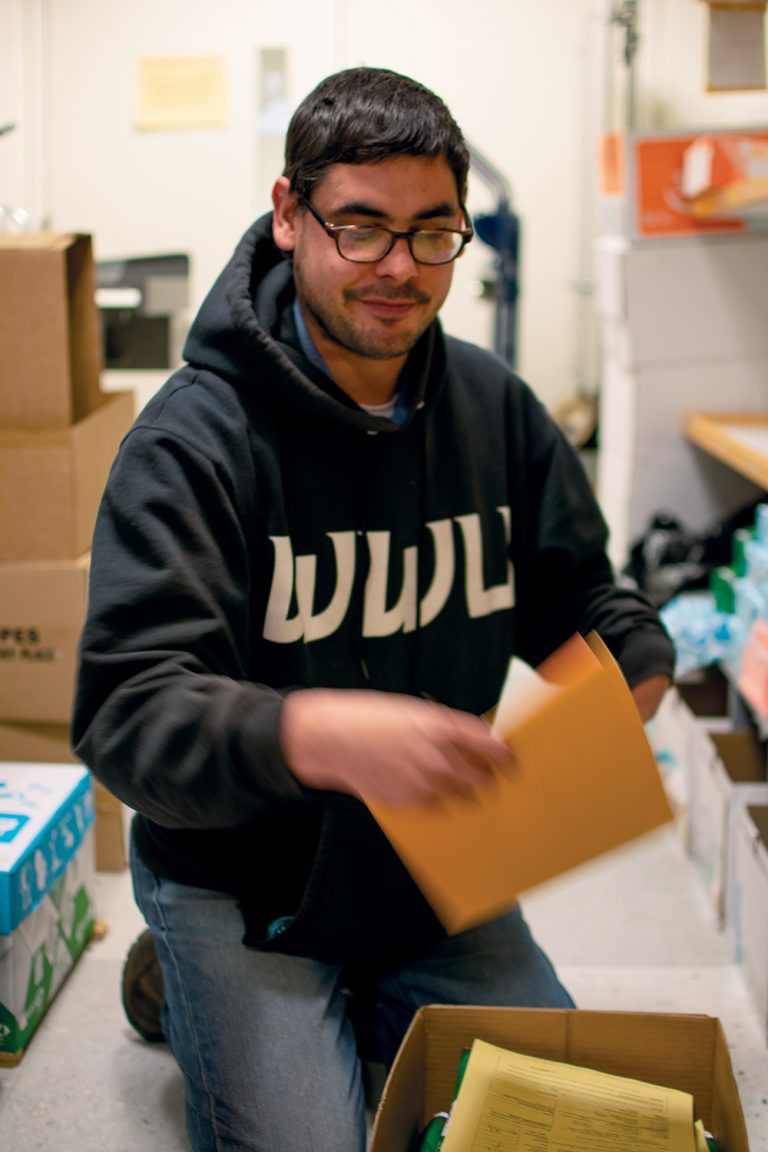
Thirteen-year WWU employee Aaron Echivarriaat work at Western’s print and copy center.

Many local companies and nonprofits hire individuals with a developmental disability. And the benefits are many on both sides—the employer and the employee.

“You get a good employee, that’s the main benefit,” said Matt Carlson, Executive Director of Kulshan Supported Employment (KSE). It is a nonprofit that provides vocational services to adults with developmental disabilities that can include Down Syndrome, autism, cerebral palsy, fetal alcohol syndrome, childhood brain injury, and more among their candidates for hire. KSE helps their clients find and maintain meaningful employment.

The Whatcom County Health Department estimates there are about 2,500 individuals in the region with developmental disabilities, though the department has no record of how many of those are seeking employment. Nationally about 85% are unemployed, 54% have Social Security as their only income, and 82% of their families say that economic security is challenged among people with developmental disabilities. (Sources: The Arc of the United States, and Washington State Apple Health.)

KSE exists to bring together local adults seeking jobs with employers who need workers. “We help our clients by learning their strengths, and matching that to job openings or carved-out positions, which is a portion of a job description,” said Nicole Mathey, Program Manager at KSE. “We do specific job development when we have someone in mind, and talk to people to see if there’s a match.”

Organizations in the community currently employ 116 of KSE’s 125 clients. Those employers include Aramark, Western Washington University dining halls, Bramble Berry, The Opportunity Council, Whatcom Transit Authority, Haggen and others.

Tasks include handling office materials, working on production lines, performing janitorial services, and more. The public, according to KSE and the Health Department, is used to interacting with employees with developmental disabilities in local grocery stores and restaurants.

Michelle Karaffa, a board member of The Arc of Whatcom County, said that many of those employed locally receive support from job coaches who go with the employee, especially initially, and help them become acclimated. Generally, Medicaid funds the support services. “It makes it easier for employers interested in hiring people with developmental disabilities because they know there will be financial support,” Karaffa said.

She has first-hand experience with her son, Austin. “With the backing of KSE, this past summer Austin was hired by the Haggen store on Meridian Street as a member of the bakery department team,” Michelle shared. “For many people with autism, like Austin, employment positions with routine responsibilities are optimal.”

Austin Karaffa hard at work in the Haggen Northwest Fresh bakery.

She said that his position has been a perfect blend of consistent job tasks combined with skills he learned in the Bellingham Technical College pastry arts program. “Most days,” Michelle said, “Austin arrives home with a flour-dusted apron, a sweaty brow, and a smile as he lists off the jobs that he completed that day.”

Executive Director Carlson said KSE pre-screens its clients. “We know our clientele pretty well. We talk to the employer and find out what they want; there’s no wasted time for employers,” he said. “And our clientele are excited to work, and dependable. They are long-term employees. If we do a good job learning what our client’s interests and abilities are, there are quite a few things they could do. As we figure out what employers need, different industries could open up. A lot of our clients, like anyone, can do different things.”

He offered high praise for the companies and nonprofits that KSE works with. “We have some champion employers in this community,” Carlson said. “They’re not hesitant to hire and place people in positions where they can reach their full potential. It’s exciting to see clients thriving at work.” And he said he sees a lot of that.

In a way, that’s what brought him to KSE. In 1989, Carlson was a college student in Bellingham with a part-time job at a rental store. One of his co-workers there had a developmental disability. “She was the only employee who was happy the whole time,” he said. “She came in, did her job, and did it well.”

Carlson eventually left that rental-store job, went to work for KSE, and was asked to stay on after getting his degree in chemistry education. He was named Executive Director in 1997. “I was going to be a teacher, and that’s what I like about supported employment,” he said. “It’s long-term. We can build relationships. There’s value in what we do. It’s something I can believe in.”

Funding for nonprofits such as KSE first became available in the late ’80s. The idea was to promote supported employment within the larger community, rather than just in sheltered workshops. KSE’s funding from federal and state sources is administered by Whatcom County. The County pays KSE on average $425 monthly for each client. KSE logs the hours spent on each client and receives payment by the hour, with caps on the billable amount.

Once an employee is trained, on the job, and communication between employee and employer is good, the KSE job coach backs off, Carlson said. “We try for 90% client independence, and check in 10% of the time. The goal is for the employer to be the supervisor, and for the client to see the employer as his boss.”

From there, he said, “We help with little things so they don’t become big. An example is helping a client understand why his regular shift might have to change, due to delivery-truck timing or something similar. “Sometimes our clients just need 15 minutes of explanation, and with that, they accept.”

In the process described by Carlson, a job coach not only helps a client know what to expect and how to interact, but helps the employer interact effectively, too. That could mean providing a picture list of steps involved in the task, or a written list rather than just verbal instructions. “As job coaches, we figure out what an employer needs so our client can be a good employee, and the employer can get results,” Carlson said.

Michelle Karaffa cited an example in her son Austin’s case: Early in his employment, the bakery department supervisors recognized that creating a written list of daily jobs would help Austin become a more independent and productive worker.  “The bakery department team and store management continue to be in his corner,” she said. “When asked what he enjoys most about working at Haggen, he will tell you, ‘Contributing to the team.’” 

KSE also communicates with its clients’ advocates outside of the job: family, care provider, or counselor. “Problem-solving goes along with helping that person become successful,” KSE Program Manager Mathey said.

“It’s awesome for that person to use their paycheck to have more financial freedom. They can afford a nicer place to live. They pay back into the taxing system that supports this. Those are all great benefits of seeing someone be successful in a job.”

That success is derived from a simple concept, summed up by Carlson: “You’re looking at the person, not the disability.”

Homeless Find Warmth at ‘Hearts to Soles’

0

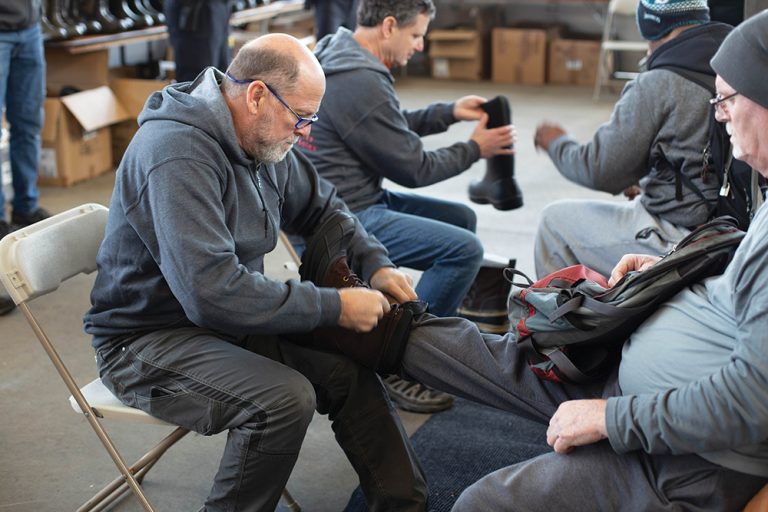
Above: Jeff Gray, Director of Outreach & Fit at Superfeet, fits a guest with footwear while Dr. Warren Taranow (background) shows a boot to another guest. 

It was beginning to feel cold and wet outside early last November—and that’s if you had warm socks and waterproof shoes. Many local folks didn’t.

Barbara Lupo coordinated an event, Hearts to Soles, to deal with almost 600 people who had little or nothing to cover their feet. For the 11th consecutive year, on November 11 an eclectic collaboration of businesses, nonprofit organizations, and 70 volunteers provided foot health assistance, footwear, other winter apparel, personal-care packets, backpacks, and a heavy dose of compassion.

“The purpose of the one-day clinic is to provide foot care, new socks, and weatherproof boots to folks in our community who were at high risk for spending most of their time outside,” Lupo said. “We get the opportunity to do medical care to treat needed issues, and provide a proper fitting for new boots.”

The first Bellingham event was spearheaded by Jeff Gray of Superfeet, Dr. Warren Tarranow of PeaceHealth Orthopedics, and volunteer Angela Gum. Four organizations took the lead for this year’s event: Superfeet, PeaceHealth St. Joseph Medical Center, Cornerstone Prosthetics, and Lighthouse Mission Ministries.

Superfeet’s volunteer team for ‘Hearts to Soles.’

And they had plenty of help.

Red Wing Shoes and Bogs Footwear donated boots. Nester Hosiery gave 500 pairs of socks. The staff of Bellingham Foot and Ankle Clinic volunteered. Sanitary Service Co. provided sani-cans and waste-disposal containers. Superfeet provided its quality insoles for each of 564 individuals.

“The clients received foot-hygiene kits along with personal-hygiene kits, coffee, juice, fruit, sandwiches, and the chance to receive a flu shot,” Lupo said. “It’s the hope of the clinic that we can mitigate unnecessary emergency-room visits caused by damp feet.”

In addition to the day-long clinic at Depot Market Square downtown, the organizers provided a separate clinic during the afternoon for residents of Agape House in Bellingham, a program of the Lighthouse Mission Ministries. Sponsored by Superfeet and PeaceHealth Pediatrics, mothers and their children at Agape House received all the same services, along with coats, hats, gloves, pajamas, backpacks, and personal hygiene kits.

Superfeet experts measured each recipient in both clinics for new-boot fittings. All giveaway items came from employees of PeaceHealth St. Joseph Medical Center’s pediatric clinic through a giving tree. Friends of Hearts to Soles supplied food and snacks.

Lupo, a former downtown business owner, said each year the need for these cold-weather contributions has increased. The number of people served in 2018 rose by 154 over the year before; the underwriting cost is shared among Superfeet, PeaceHealth, and generous volunteers.

“As a 100-percent, employee-owned company, we’re deeply committed to bringing out the best in our community,” said Gray, Superfeet’s Director of Outreach and Fit. “We believe that everyone deserves to live a pain-free and more comfortable life. By partnering with Hearts to Soles, we further our commitment to building strong foundations that positively impact the world around us.”

Hans Erschinger-Davis, Executive Director of Lighthouse Mission Ministries, said that the donated items and services are crucial to the well-being of many homeless or sheltered persons who otherwise would incur health problems associated with winter weather. “Foot-care is one of the most major issues facing the homeless of our area,” Erschinger-Davis said.

“Tromping on the streets all night in the rain to stay warm does a number on one’s feet. Heart to Soles’ big-hearted annual effort to fit shoes and address foot ailments is an important piece of the puzzle helping people better their lives.”