
Historic company looks forward

Bellingham Cold Storage is a pillar on working waterfront
Cheryl Stritzel McCarthy
Iconic. Vibrant. Historic. Futuristic. Bellingham Cold Storage, a fixture on Bellingham’s working waterfront for almost 80 years, is all of these.
BCS is a cold storage and frozen food processing company that started as a local endeavor in 1946 and grew into a global company with local, regional and international customers.
The scale of BCS
One way to sense the scale of Bellingham Cold Storage is to picture every semitruck that’s loaded or unloaded at BCS in a year, parked end to end.
“They would extend south from Bellingham to Seattle, then east to Boston and back to Chicago,” said BCS President and CEO Doug Thomas. “That’s a traffic jam!”
BCS employees pick up and put down over 3 billion pounds of product each year, including initial harvest receiving, freezing, placing in the warehouse, returning product to value-added processing on-site, and again to the warehouse before eventual distribution to points around the globe by truck, ship or rail, Thomas said. About 45 percent of that is seafood, with 35 percent fruit and vegetables and the rest cheese, ice cream, pet food, bakery products and other goods.
Walk into the soaring space of a BCS warehouse, this one for dry storage, and get another sense of scale. A single bag of oats is the size of a small car, and these massive bags are palleted aisle after aisle, nearly to the ceiling.
More than 600 BCS customers store ingredients here.
“Every customer has at least 20 items and some have hundreds of items,” Thomas said.
Chia seeds, nuts, soups, sauces, tanks of honey, freeze-dried oysters and clams, salts, sugars, whey, packaging supplies…
“A multitude of things,” Thomas said, waving a hand toward a huge pallet of glass peanut butter jars. Bar codes keep track of every item, so product is rotated and nothing gets forgotten.
Oats? Isn’t BCS all about ice and fish?
In the 1940s, Arch Talbot was the owner of a shipyard on Bellingham’s waterfront that built wooden-hull minesweepers for the military. With the close of World War II, he constructed an 18,000-square-foot warehouse and ice house to provide cold storage for local fishermen and farmers.
That initial warehouse is still in service.
“Take care of things and they last,” Thomas points out.
The BCS Ice House, rebuilt in 2012, is a modern wonder. Enter its upper level and it is suddenly winter. A clear, cold, indoors kind of winter, with glittering ice crystals sparkling in the air. Below, see the huge, flat containers of flake ice that are auto-raked smooth. At 20 degrees Fahrenheit, the flakes stay perfect, neither melting nor melding into a mass of snow. Above, see pipes that carry the air-driven ice flakes out of the building directly into the holds of fishing vessels at the dock. (Before 2012, this was done by moving 315-pound blocks of ice into a grinder above the fishing vessel.)
Today, the Ice House, tended by technicians in a comfortable control room aglow with computer screens, can produce 530 tons of ice daily, much more than previously produced manually. Ice is required for initial harvest preservation, for product that is processed before shipping fresh or freezing for longer term storage, and for outbound fresh shipments, Thomas said.
Technicians also tend computers that show temperatures in the Fish House, which can process 200,000 pounds of salmon, fresh to frozen, daily. Totes of fish from fishing vessels are tipped onto multilevel conveyor belts that gradually lower their load from 35 F to minus 10.
Historic but futuristic in equipment and outlook
“We recently completed a 50-year lease extension with the Port of Bellingham for our Squalicum Waterway facility, which will take us to 2074, or 128 years on Bellingham Bay,” Thomas said. “That allows us to make long-term capital investments, now that we have a lease that extends beyond the useful life of most new projects. We are excited about that prospect and are busy planning next steps.”
BCS remains a privately held company. The historic Seattle-based company Joshua Green Corporation is a 60-plus percent majority owner, and Stowe Talbot and Doug Thomas are minority owners.
Thomas has worked at BCS for 32 years and counting. When asked what he’s proudest of, he speaks of the legacy of the Talbot and Thomas families, highlighting devotion to employees, customers, service partners and community.
“I’m proud of the way our leaders have represented BCS while serving on various local, state, national and international boards and committees. I’m proud of the leading-edge initiatives that our teams have navigated, including energy, health care, software, KPIs (see sidebar), ship loading, life safety, employee working environment and now automation. I’m proud of the positive and credible reputation BCS has for being fair, following through with commitments, and being compassionate and accommodating to our employees and customers when they need us most. I’m proud to have been associated with Archie, Jim, Jane and Stowe Talbot and certainly I may be most proud of my father, Stew, who was our CEO for 13 years before me and continues to serve on our board of directors (50 years as of April 2024).
“I like that our employees can live in this great community and have a reasonable commute to work and have a great place to raise a family.”
BCS donates to more than 70 charities, mostly local, and emphasizes young children. For example, the YWCA’s service to single mothers.
“The moms there with young kids need some help,” Thomas said. “You’re better off investing in kids between ages 0 and 6 than you are trying to catch up when they’re 18 or 20.”
As for employees, Thomas walks the walk. When he took this reporter through the company’s cavernous indoor loading dock, an employee approached Thomas to thank him for donating Thomas’s own sick time so the employee could travel out of state for a family emergency.
As for community, Thomas and BCS were among the first members of Whatcom Business Alliance, formed decades ago to support good businesses; the meaning of which, Thomas said, is “businesses in compliance with regulations, that are responsible, where employees are proud to work.” WBA, publisher of this magazine, advocates for those businesses and tells their stories. It’s all part of what makes this steady pillar of the community both important and iconic.
Farming’s future uncertain

Whatcom farmers wrestle with high costs and regulations
Mary Louise Van Dyke
Fred Likkel, executive director of Whatcom Family Farmers, doesn’t wear rose-colored glasses when discussing the state of farming in Whatcom County.
“Overall, the reality of farming is that we compete on an international scale, which means that often times, we have to compete against those who can raise their food significantly cheaper,” Likkel said.
Whatcom County has about 100,000 acres of agricultural land, and the number of mid-sized farms is decreasing while the number of large and small farms is increasing. This info was shared by Chris Benedict, a professor of agriculture at Washington State University’s Whatcom County extension, at the May 8 Whatcom County Agricultural Advisory Committee meeting, using data from a 2022 survey from the United States Department of Agriculture.
County farmers are having to deal with a number of thorny issues at present,
Likkel said.
Wages
Farm labor costs have risen significantly alongside inflation and increases in the minimum wage. Whatcom farmers pay their agricultural employees more than farmers who live in lower-cost areas do. The state also now stipulates that farmers must pay overtime, a requirement unique to Washington and a handful of other states, Likkel said.
“That requirement has created a significant stress for farmers and their bottom line,” Likkel said.
Equipment costs
Inflation also has increased the cost of purchasing equipment. A tremendous amount of capital expenditures are necessary in agriculture, and farmers must compare the costs of labor and machinery. A dairy farmer, for example, could choose to purchase an automated milking system in which minimal human interaction is needed.
“So, you’re looking at some big investments to achieve labor savings — if the farmer has decided to continue operations,” Likkel said.
Water adjudication action
Whatcom farmers who work in the Nooksack River and Sumas River watershed areas (as well as residents in those areas) are facing a water rights adjudication action filed in May by the Washington State Department of Ecology, according to the Whatcom County website. The action exempts people who receive water from a city or other water provider.
“For farms, water is the most critical component to survival,” Likkel said. “Without water, you don’t have a business, especially for those who are raising crops.”
The adjudication has created a situation of enormous water insecurity. Determining who possesses water rights — or who doesn’t have water rights — could take 20 or 30 years, Likkel predicted.
“You could end up where you thought you might have water and you don’t have it anymore,” he said.
Likkel doesn’t think anyone living in areas covered by the adjudication can take a hard look at this issue and say it won’t impact them. There are a limited amount of water rights out there.
As a result, farmers are again pressed to explore hard choices. They will need to hire water rights experts and attorneys to defend what rights they may or may not have, which will be expensive.
The process already has been delayed, and uncertainty and the prospective high costs are leading some people to make tough decisions. Is this the last straw, or can they envision themselves still raising raspberries and blueberries or seed potatoes in the future?
“We are seeing some people who are getting out of farming because of that,” Likkel said.
Environmental concerns and audits
Water isn’t the only thorny environmental issue that farmers face.
Farmers, not just in Whatcom County, are required to run audits to show compliance in their operations, according to safeagsystems.com.
Likkel, a former agricultural environmental consultant, said farmers go through audits, sometimes right in the middle of their busy season, to ensure crops meet the marketer’s (such as Costco) standards for food safety practices to reduce chances of spreading listeria infections, for example.
“Our farmers are doing really well,” he said. “We can make a really good case that we’ve done really well on what we’re doing to protect the environment, but it does add a significant cost.”
Fuel costs
“The Climate Commitment Act considerably jumped our fuel prices,” said Likkel.
That law, signed by Gov. Jay Inslee in 2021, established the state’s cap and invest program to reduce greenhouse gas emissions, according to the news website Washington State Standard. The law is currently being challenged by Initiative 2117, included on the November 2024 ballot in Washington state.
Initially, farmers were supposed to be exempt from the requirement to cap their exempted emissions, including those from fuels used for agricultural purposes, but the Department of Ecology failed to secure that exemption.
The matter is mostly resolved, but there are still places where it’s an issue.
Farmers’ future plans
“There’s a lot of hard questions being asked about if farmers want to continue to farm,” Likkel said. “Do their children want to take over the farm? Or is it more realistic to sell land to a developer for houses? Whatcom land prices are high.”
The county’s prime location has made that question all the more difficult.
“We feel a lot of pressure on land prices from the north and south (Skagit County) borders,” Likkel said. “Canada has some very high prices for farmland. So that’s leading again to the hard questions people are asking if they want to continue farming or not.”
Despite higher land prices, the quota system in Canada has helped keep more farmers farming, Likkel said. British Columbia
farmers are responsible for producing stipulated amounts of eggs or milk, for example, to ensure a continuous and safe supply of food, according to the British Columbia
government website.
“Canada, regardless of how you feel about the system, protects their farmers more. They give them quota,” Likkel said. “They protect their agricultural land more, but
Canadian agricultural land is also worth considerably more.”
As this spills over into the United States, it becomes an issue for Whatcom
County farmers.
“So, [what happens] if a Whatcom County farmer, who may be a second or third generation or fourth generation, knows their son isn’t interested in continuing to farm?” Likkel said. “The land becomes available for sale, and a Canadian farmer who feels the pressure, who wants to grow crops and can’t afford an acreage in Canada, may be interested in purchasing the lower-priced Whatcom farmland.”
This has been happening.
“I’ve even seen in one case this past year where a couple hundred acres of Whatcom farmland is now owned by an investment firm,” he said. “I would not be surprised to see that happening more. For them, if they’re strictly looking at land as an investment, agriculture land values continue to rise.”
Knowing the local farmers, though, Likkel remains hopeful.
“Our farmers are a resilient bunch,” he said. “They love farming, and they love to be here. A number of us say we plan to be here. However, it is becoming increasingly difficult to have that optimism.”
They can do it, but they’ll need help.
“We need to continue to work with our partners and our local and state governments,” Likkel said, “to ensure farming is viable here.”
Let’s hope Boeing labor agreement marks start of a new phase of manufacturing growth

Shortly before the vote that ended the Machinist’s strike against Boeing, an unprecedented group of 53 manufacturing association and state chamber of commerce leaders from 42 states signed on to a joint letter urging both sides in the dispute to get back to the bargaining table an find a way to end it.
“The health of the United States aerospace industry is at stake, and more importantly, the livelihood of aerospace workers who are the heart of the industry,” the letter stated. “There is no time to waste. We urge all parties to reach agreement to end this strike before it’s too late.”
Thankfully, that’s exactly what happened.
While the timing of the labor agreement, just a day after the letter was sent, is no doubt a coincidence, it was still striking — and encouraging — to see a group that large mobilize so quickly to lend its voice to the issue. It was indicative not only of the importance of the aerospace sector to the nation’s economy, but also the importance of aerospace jobs to Main Street shops and restaurants across the country.
The aerospace industry directly employs more than half a million people in the U.S. and supports more than 2.2 million jobs. The sector produces $425 billion in the U.S. economy and exports more than $135 billion worth of products.
Here in Washington, the impact is especially large. In 2023, aerospace manufacturers supported 194,000 direct and indirect jobs, paid nearly $20 billion in labor income and generated $71 billion in revenue for Washington businesses, according to a recent report on the impacts of the Puget Sound’s aerospace industry published by the Seattle Metropolitan Chamber of Commerce.
The report, published before this fall’s strike, told a “recovery story” of an industry on the rebound after the grounding of the 737 MAX and the pandemic. In 2019, Washington’s aerospace industry had 88,500 jobs, a figure that dropped to 67,500 in 2021, Since early 2022, those jobs have steadily returned and as of this July, aerospace employment was up to 81,8000. Boeing accounts for roughly 80% of aerospace jobs.
Snohomish County is home to many of those employees, but the economic ripple effect is significant. In Auburn and Renton, aerospace employees were responsible for 2.4% of restaurant sales in 2023, directly supporting 420 restaurant jobs, or the equivalent of 35 restaurants.
In Everett, a car dealership tracks the ups and downs of the aerospace industry and notes that — no surprise — when aerospace employment is up, so are car sales. The same kinds of stories play out all over the state, from Skagit County and Whidbey Island to North Bend and Moses Lake.
And they play out across the country, too. That’s why 53 organizations from 42 states — from Alaska and Arkansas to West Virginia and Wyoming and nearly everywhere in between — quickly agreed to include their name on a letter calling for an end to the costly strike.
Thankfully, the parties were able to find agreement to end the strike before it caused even more economic damage. We’re hopeful that with a new labor agreement comes a new era of manufacturing growth in Washington — and across the nation.
Kris Johnson is president of the Association of Washington Business, the state’s chamber of commerce and manufacturers association.
Mixing Roles

Former soap opera star and Sehome High grad takes cocktails to a new level
Matt Benoit
To Matthew Twining, the perfect cocktail is the one that speaks to whatever moment and mood someone finds themselves in.
The 44-year-old Whatcom County resident — and owner of the downtown Bellingham bar Matthew’s Honest Cocktails — describes the cocktail as an honest lubricant for the social experience. And as a longtime bartender and former professional actor, he’s acquired a good handle on cultivating the right mood at the right time.
“I know [it’s the right cocktail] when I see people’s eyes, or when I see them take that first sip and then they just kind of sink into their chair,” Twining said.
Business has been steady since Matthew’s Honest Cocktails first opened in August 2022 in the former longtime Starbucks location at 132 E. Holly St. Twining and five other bartenders operate the modern and elegant watering hole, with the bar’s many windows beckoning patrons inside, seven days a week, at the corner of Holly Street and Railroad Avenue.
Living in the limelight
Twining’s journey to bar owner has had many plot twists. Born in La Jolla, California, Twining came to Whatcom County with his parents as a baby.
His father, who went on to become a successful financial adviser, used what money he had then to buy a small piece of property in Sudden Valley. It came with a barn, which is where the family lived for nine years, sans modern conveniences like television and running water.
The formative experience gave Twining an appreciation for family, friends and the little things in life. Another formative experience came from vacationing with his parents in Italy as a young boy. The trio encountered a band of gypsies and decided to live with them for several months. Twining said the experience awakened him to the power of words, music and performance — and the knowledge that art can be found everywhere.
His journey into acting began when he read his first play — William Shakespeare’s “A Comedy of Errors” — in grade school. When Twining attended Sehome High School, local thespian Teri Grimes was his drama teacher and cast him as a loveable hobo in his first play, “Scapino!”
Twining did additional stage work with the Bellingham Theatre Guild, and after graduating from Sehome in 1999, he moved to Los Angeles in 2000 to embark on an acting career.
“It was a massive learning curve for me,” he said.
Twining booked whatever acting gigs he could get, including direct-to-video horror films like 2003’s “Leeches!”
In 2004, Twining was cast as the “bad boy love interest” of a main character on the long-running ABC soap opera “One Life to Live,” necessitating a move to New York City. He remained there for three years and is still friends with his character’s “ex” – “Brooklyn Nine-Nine” actress Melissa Fumero.
The time in NYC, Twining said, allowed him to more properly cut his teeth as an actor, finding the many differences between television and Broadway acting in a sometimes humbling manner. He also gained brief bartending experience as a way to make additional money.
Back to the Wild West
In 2007, Twining moved back to LA. He continued acting in low-budget movies, including the 2006 kung fu film “The Adventures of Johnny Tao.” Twining was cast as the lead character, who uses his father’s old guitar to defeat an army of “donut-eating kung fu demons,” according to IMDb. Twining did his own stunts for the movie.
“Those were fun things to film,” he said of B movies. “You feel like you’re on top of the world when you’re on a set. There’s nothing like it.”
His second go-around in LA also led to life as a musician. As the songwriter, guitarist and vocalist in the band Odaal, Twining was able to frequently record and tour the West Coast with the band, which he describes as a four-piece group with a “folk punk” or “rattle pop” sound. The group is currently working on one of its final albums.
Twining was also able to use the money he’d earned acting to buy his own recording studio. Besides frequent band recordings, Twining’s studio was used for video game soundtracks and voiceovers for animated shows and commercials. Once, ZZ Top’s Billy Gibbons popped in to record a whiskey ad.
While working as a musician, Twining met the woman who’d become his wife. The couple had their first child in 2010 and now have three boys, ages 9, 11 and 14. The year after becoming a father, Twining felt coming back to his roots would be a better place to raise a family. He loved the geography and multiseasonal weather in Whatcom County, and his family was also here.
“I loved [acting],” he said. “But I hated the business part of it. I knew that it was time to engage in maybe a different side of business.”
A dream and a dram
After returning home, Twining found a passion for bartending and spirits after becoming involved with the Bellingham Bourbon Society.
“I started to understand whiskey and why the American cocktail culture was important,” he said, “and what it actually did, historically and culturally.”
Twining began bartending at the Silver Reef Casino and other places before finding a longtime home as bar manager at Bellingham’s Springhill Suites by Marriott, where he worked for seven years.
During the COVID-19 pandemic, the longtime Starbucks location at Railroad and Holly closed after several decades. The landlords didn’t want a bar to replace it, but Twining began what he said felt like an audition process to convince them of his idea for one in the space.
Once they agreed, Twining and a designer set about crafting an inviting cocktail bar that provides plenty of space to mingle, including a curved bar to encourage interactions. The location was also serendipitous for Twining: His father once ran a business nearby and was among the first-ever customers to the former Starbucks.
Since opening, Matthew’s Honest Cocktails has cultivated a loyal cast of regulars, in addition to college students wanting to impress a date or provide visiting parents a nice evening, Twining said. The bar features plenty of seasonal specialties, as well as nuanced variations on classic cocktails like the negroni, old fashioned and mojito.
Matthew’s Honest Cocktails also serves a “Dram of the Moment” — a specially selected and bottled whiskey courtesy of the Bellingham Bourbon Society; Matthew’s is the only bar in town that serves it.
Although Twining said he was initially hesitant to add his name to the bar’s title, he said its mention of honesty invokes what he’s learned from his time in acting and music.
“If you are not honest — if you’re disingenuous in your craft — people know,” he said. “Your audience is not dumb. You have to listen earnestly, and people will pick up on that. And people appreciate an honest listener — in acting, in music, certainly in bartending, but also in business.”
Twining said he hopes that honesty comes across in both the quality of his bar’s cocktails and the bartenders who pour them. A good bartender, he believes, should be a “master of moods,” helping stoke the coals of interaction that are the underlying reasons most people go out to drink.
And despite no longer being a professional actor, Twining hasn’t abandoned his first love: He performs in one or two plays a year with the Bellingham Theatre Guild. Last year, he received the guild’s Bentley Award for
Outstanding Supporting Performance in a Male Role.
Whether onstage or behind a bar, the challenge of communicating to an audience never gets old for Matthew Twining.

Watt’s next?

EV-olution hits the road in Whatcom County
Matt Benoit
If you’ve recently felt as if you’re seeing more electric vehicles on the road, you’re not wrong: There are now more than 4,600 electric and hybrid vehicles registered to Whatcom County residents, according to recent Washington State Department of Licensing data.
In Bellingham itself, the number of registered EVs have more than doubled in a two-year span, from just over 1,200 in 2022 to around 3,200 in 2024.
More than 1,500 of those vehicles are 2023 and 2024 model years, showing that consumers are more and more rapidly adopting these more efficient and environmentally friendly technologies. The increasing number of electric and hybrid vehicles joins growing electrification efforts in other areas of our community, including the public transit system.
On the lot
Government incentives also help drive a desire to transition to EVs.
These incentives include a brand-new instant rebate program from the Washington State Department of Commerce, which recently began offering savings between $2,500 and $9,000 on new and used EVs for state residents making 300 percent or less of the federal poverty level. The program began Aug. 1 and will last until June 2025 or when funds run out.
Dealerships that offer point-of-sale rebates to eligible customers will be reimbursed by the program.
That’s good news for people like Julian Greening, general manager of Bellingham Ford. Julian’s James Street car lot is filled with trucks and SUVs, plus a few sports cars. The dealership’s electric offerings include the F-150 hybrid, the Ford Lightning EV pickup and the Ford Mustang Mach-E.
Julian said he’s seeing about an 80 percent retention rate for consumers leasing electric vehicles, and hybrid and electric truck models also are selling well at his dealership. Ford is currently the nation’s second-largest EV producer by volume, he added. The manufacturer trails only Tesla, whose vehicles make up roughly 30 percent of Whatcom County’s EV population, according to Department of Licensing data.
Car manufacturers’ increasing commitment to electrification, Julian said, is partly due to government pressure to meet increasing standards for lower emissions and higher fuel economy in newer vehicles. Failure to achieve those numbers, he added, can result in additional taxes for the vehicles dealerships sell.
“One way to offset that is hybrid and EV sales,” Julian said. “The reason why Ford has ventured into the EV market is so as to offset the carbon problems with having these gasoline and
diesel trucks.”
Despite increasing sales of EVs, Julian said that manufacturers are still losing money on EVs. But they’ll continue producing them as long as there are financial offsets from traditional internal combustion models and government incentives for consumers. Government support may change over time, he said, depending upon who occupies the White House next year.
Bellingham Ford has spent ample funds — about $500,000 — on electric infrastructure, Julian said, including nine electric charging stations on its lot. The dealership building had to be rewired, and Puget Sound Energy needed to bring in additional electricity.
Julian chose local contractors, including Ram Construction and VECA Electric, to make these changes, he said, keeping at least half of the expenditure local. Bellingham Ford also has several electrically certified mechanics on staff capable of tackling just about anything, he added.
Over at Iowa Street’s Swickard Auto Group, which sells Volkswagen, Audi and Porsche vehicles, General Manager Dustin McLean said customers are definitely asking questions about EVs. Overall, however, market trends show hybrid vehicles are currently more in demand than fully electric ones.
“It’s a nice entryway for people who don’t want to fully adopt and are on the fence, which is a pretty large group of people,” he said.
On the Swickard lot, electric options include several SUVs like the Porsche Taycan and Volkswagen ID.4, the latter of which currently makes up about 4 percent of the county’s electric vehicle population. On the hybrid side, models include the Audi Q8 plug-in SUV, which will be joined on the lot next year by the Audi Q5 SUV, Dustin said.
Over the next two to five years, Dustin said he expects hybrid sales to continue rising in the auto industry, helping more consumers gradually transition into full-fledged EVs.
Guy Occhiogrosso, president of the Bellingham Regional Chamber of Commerce, also envisions a short-term future with more hybrids.
“I think there’s a lot of value in hybrid technology,” he said. “I’m a big believer that diversity of all kinds is important. Having a vehicle that has energy diversity may not be a bad thing either.”
Guy sees electrification’s future as one in which communities must confront how they wish to innovate, whether it’s encouraging greater EV use or restricting the use of internal combustion engine vehicles.
The latter would likely be unhelpful in changing consumer behavior in places like Bellingham, where there are currently concerns about the cost of living; some EV models, he pointed out, are quite expensive.
If there is a future in which more people drive EVs than internal combustion engine vehicles, Guy said it will likely happen only when the used market for EVs becomes more robust.
“We have to have that technology catch up to produce vehicles that can stay on the road and then have people cycle those to used vehicles,” he said. “Once we have used vehicles on car lots being a majority of EVs, then I think that’s when we will start being able to really see that difference.”
Infrastructure concerns
An increase in fully electric vehicles will, in many areas, depend on how prevalent charging stations become. Many consumers, Dustin said, may also be waiting on EV range and charging speeds to improve before taking the plunge, based on their lifestyles.
“Not everybody has the luxury of being able to charge [a vehicle] at work or have a fast charger at home,” he said. “The charging structure, in general, needs to get caught up.”
Due to charging frustrations, very few people Dustin has spoken with about longer EV trips have had
positive reviews. Often, stations they’d planned to recharge at weren’t fully installed or functional, impacting their travel schedules.
Julian said that while there’s little doubt EVs are generally positive for the environment, there are still plenty of concerns about how quickly infrastructure can be built to meet increasing demand, whether power grids can accommodate that increase, and whether the increased electricity is being generated cleanly.
“For the consumer that wants to purchase a vehicle and put it in their driveway, there is going to be less environmental impact,” he said. “But then when you go plug the thing in at the end of the day to recharge … where’s that power coming from?”
Dustin said several things need to be done in order for greater vehicle electrification to continue: consistent operation and timely maintenance of existing charging systems and a commitment from businesses and retail centers to feature more chargers. That could include incentives for offering such infrastructure, both to customers and the businesses themselves.
While Guy is unsure how much public funding should be put toward expanding charging stations, he agrees that it should be easier to find them.
“We should make it readily available and easy to implement charging stations, because they’re not going to go away,” he said. “I think the city can maybe have certain conversations about parking stall charging.”
Regardless of what the future holds, Julian sees the move toward greater electrification as a net positive for communities.
“I believe EVs are good for what it is we’re trying to do,” he said. “I don’t think it’s worse than where we currently are.”
The future of public transit
The county’s public transit system is also continuing to undergo electrification.
The Whatcom Transportation Authority fleet, which consists of 63 fixed-route buses, currently has eight hybrid models and four electric buses to go along with its 51 diesel-powered ones, said WTA General Manager
Les Reardanz.
That’s double the number of electric buses it had two years ago, and another eight will be delivered by year’s end. Along with eight more new hybrid models (some of which will replace older hybrids), WTA’s fleet should be 35 percent low or no emission by the end of 2024, Les added.
The new 2024 buses were purchased through the Federal Transit Administration’s Low or No Emission Grant Program.
WTA plans call for replacing eight more diesels with hybrids in 2026 and another six in 2028, with three additional zero-emission buses scheduled for delivery in 2027.
All told, this would position roughly 60 percent of WTA’s 2028 fleet away from diesel power.
The transit provider’s larger goal is to fully transition its fleet from fossil fuel by 2040, something that Les feels is achievable. There is uncertainty in what alternative energies will power that fleet, however, and one of them may be hydrogen.
AltaGas, a Canada-based energy company, wants to build a green hydrogen plant at the former Intalco aluminum smelter at Cherry Point.
The overall goal, according to the Pacific Northwest Hydrogen Association, is a carbon-free electric grid by 2035.
Les said he understands that AltaGas may begin producing this energy by 2027 or 2028.
If that happens, it would fundamentally change the local energy market and could send WTA’s no-emission buses down an infrastructure path based more on hydrogen fuel than electric power.
“This is kind of a game changer,” Les said. “If you can get green hydrogen here in Bellingham, that cuts down on all the costs of transportation. The supporting infrastructure to put in hydrogen is much cheaper than electric.”
In the meantime, WTA is focused on providing enough electric charging stations for its current fleet of EVs. The company has just two at its WTA base station, but Les said it plans to have a dozen (one for each bus) installed by year’s end.
WTA also installed a backup charger at the Cordata neighborhood station, in partnership with the city of Bellingham.
As well, WTA is still working to troubleshoot occasional issues with its EV fleet, including coordinating software upgrades to specific bus systems and managing battery
and charging efficiency in extremely cold weather.
But battery technology continues to increase power and range over time, and WTA’s technicians have adapted well to dealing with electrification, Les said.
As an individual, Les said he is worried about the power grid’s ability to keep up with the escalating demand that electrification will bring, encompassing vehicles, homes and even data farms.
“That grid is all intertwined,” he said. “If they’re using a lot of that in Douglas County, what does that do for the ability to get electricity here?”
Still, Les is excited about the future, and he expressed confidence that both WTA and the wider world will figure out how to be less dependent on fossil fuel.
“We kind of know this is all going to get worked out,” he said. “It’s just on what timeline, and what does it look like at the end? We just need to see how the technology and the market kind of shakes out.”



Fresh, organic produce delivered to your door

Dandelion Organic Delivery makes eating healthy affordable and easy
Tamara Anderson-Loucks
Since the COVID-19 pandemic, 50 percent of adult American consumers now prioritize a healthier approach to eating, according to the National Center for Biotechnology Information, including consuming more fresh produce and organic foods. However, sourcing fresh organic produce can be an expensive and time-consuming task. But it doesn’t have to be. Bellingham-based Dandelion Organic Delivery brings local, organic fruits and vegetables right to your door. The company’s mission is to deliver nourishing produce direct to people’s homes or offices, saving people money and time and making it easy for families to eat healthier.
Dandelion Organic is the brainchild of Bellingham residents Jonny Lane and Maria Stavrakas. The couple longed to work for themselves in a capacity that fueled their passion for healthy food and sustainability and would benefit their community. Around 2006, they visited Bellingham and believed that it would be the perfect location for this type of business.
On April 1, 2007, with their business plan in hand, the couple moved to Bellingham and made their first delivery of 24 bins one month later, on May 1. Over the next few years, Dandelion Organic steadily grew, primarily through word of mouth, and was profitable enough to fund the construction of the building they still occupy today. The company experienced a huge spike in business during the COVID-19 pandemic as area residents sought options for food delivery.
Though many businesses are currently feeling the economic pinch, Dandelion Organic’s sales have remained fairly consistent. However, managing business fluctuations is status quo for Jonny and Maria.
“It’s a business where customers come and go, sometimes due to economics or because a customer moves,” explained Maria.
Jonny added, “We also lose some business in the summer because people go on vacation and grow their own produce.”
Today, Dandelion Organic averages 500 weekly deliveries. Jonny and Maria attribute their success to their exceptional team; exemplary customer service; the ease, convenience and savings that online ordering and delivery provides their customers; and the high quality and diverse selection of the organic produce they offer.
Harvesting the bounty from local organic farms
Sustaining the home-delivery model is a full-time operation for Dandelion Organic’s 15-person crew. The company does not grow the produce it sells, instead partnering with organic farms throughout Washington state, purchasing fruits and vegetables weekly to provide fresh-picked produce for customers.
The company currently works with about 30 organic farms in Okanogan, Skagit and Whatcom counties. Much of the fruit comes from Okanogan County. During the local growing season, 100 percent of the fruit and vegetables offered are supplied by local farmers.
“We are a year-round service,” Jonny noted, “so in the winter months, to supply what we can’t grow here, we work with distributors that source organic produce from other states.”
Dandelion Organic’s offerings change weekly and seasonally based on availability and the best value at that time. All year round, the business offers more than 50 different fruits and vegetables weekly.
Customer-centered
ordering and delivery
Dandelion Organic simplifies the process of ordering food online, offering three different options: an all-fruit bin, an all-vegetable bin and the harvest bin, which is 70 percent vegetables and 30 percent fruit.
Bins are available in two sizes and are customizable. The $42 bin feeds two to four people per week, and the $34 bin feeds one to three.
Menus are changed weekly; however, customers have the option to customize their weekly orders.
“Customers can make substitutions to their orders, but within their accounts they can also set permanent exclusions to automatically exclude items they don’t want and set specific additions as recurring items as well,” Maria explained. “They can also skip an order and add products to that week’s offering.”
Customers can choose to donate their bin to the food bank, as well, if they are out of town that week.
Delivery frequency can be set to weekly or biweekly and can be paused, so customers can control the amount of produce they receive.
Currently, Dandelion Organic Delivery serves Bellingham, Birch Bay, Blaine, Ferndale, Lynden and Sudden Valley. For customers outside these delivery zones, in-person pickup is offered at the company’s warehouse in north Bellingham. Jonny noted that only a few ZIP codes are outside the delivery area.
“Folks can check on our website to confirm if we deliver to their locations,” he said. “For anyone who lives outside of the delivery zones, if their work locations are within the zones, we can deliver there.”
Eating organic produce can be affordable
Part of the Dandelion Organic mission is to make it more affordable to eat nutritious and organic fruits and vegetables. The cost to have organic produce delivered is comparable to grocery store pricing. However, customers save time by reducing trips to the store and save money because they are driving less and have fewer opportunities to buy on impulse.
With rising inflation and food costs in recent years, Dandelion Organic has been able to maintain stable pricing. Jonny and Maria attribute this to their conservative business model. Their home and warehouse are co-located, so they don’t incur the high cost of commercial rent, and utility costs are minimized by the use of solar power.
“From the time we opened the business until now, our bin prices have increased less than 50 cents per bin per year,” Jonny said. “Our smaller, biweekly delivery breaks down to just $17 per week.”
Sustainability is a core value
Coupled with Jonny and Maria’s commitment to providing healthy and organic food is their passion for sustainability. Dandelion Organic’s sustainable operations help foster a healthy environment. The company offers a plastic recycling service to all delivery customers. The business also produces less than a handful of non-reusable and non-recyclable trash each week. All remaining trash is either reused, recycled or composted.
Food is not wasted. Delivery bins are hand packed, and if a packer notices an item that is not sellable but still edible, it is either eaten by staff, used as animal feed or composted.
Even the company’s printed materials are sustainable, printed on paper made from sugar cane fibers.
All deliveries are made in reusable totes, which are washed prior to being reused. The totes eliminate the need for cardboard or wax-coated boxes; some of them have been in circulation for 10 years.
A year ago, a second solar array was installed on the warehouse roof.
Between the two, Jonny and Maria now have enough to power their operations year-round.
“Showing love for the planet is a core value for us,” Maria said. “Conservation and food management is important. We work towards zero waste.”
Why ‘Dandelion’?
The name is steeped in Maria’s Greek heritage. She grew up harvesting dandelion greens with her family on the edges of farms outside of Baltimore. Dandelions have both medicinal and nutritional benefits. It’s a common practice in Greek villages to harvest dandelion greens, cook them and eat them with olive oil, feta cheese and bread.
“The name was inspired by a strong connection to my family’s Greek origins,” Maria said. “We also import and sell olives and olive oil from my family’s farm in Greece.”
Adding more fresh produce and organic foods to our diet is a great start to living a healthier lifestyle. Sourcing fresh and local organic produce takes time and effort, but Dandelion Organic Delivery has done the legwork necessary to provide an accessible and cost-effective way to accomplish both.
Cross-border trade vital to WA economy
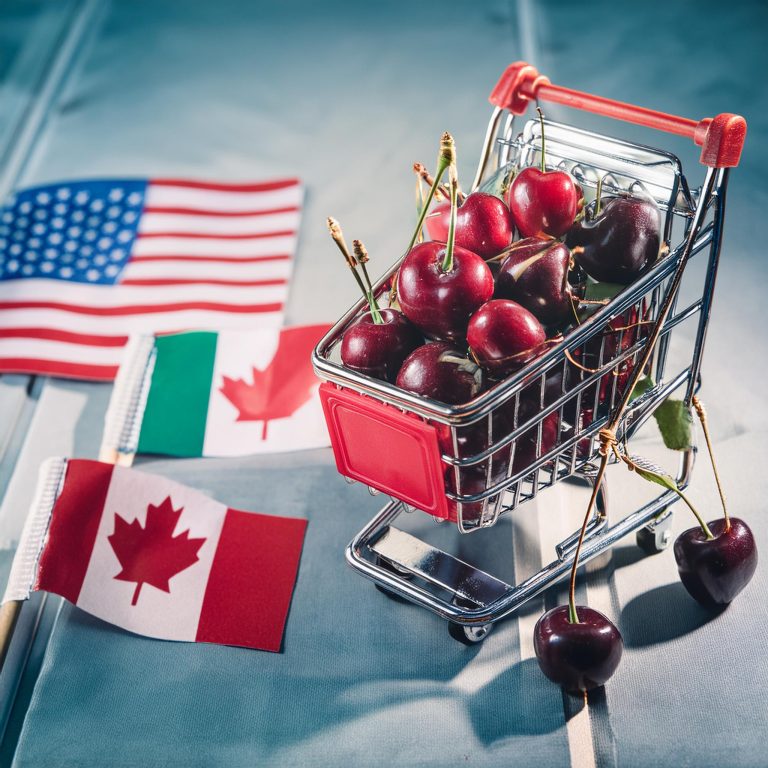
It’s a tradition for the Association of Washington Business to visit the local Costco during our international trade missions. AWB’s trade mission to Canada in June was no different. Our delegation that included several Washington growers saw their cherries, apples and sweet onions in a busy Costco in downtown Vancouver, British Columbia.
We can proudly say Washington is one of the most trade-driven states in the nation. Trade supports jobs in every corner of our state — and Canada is one of our top trading partners. It’s also our number one export market for agricultural goods.
We don’t — and shouldn’t — take this for granted.
The Canada trip was AWB’s fourth international trade mission, after visits to Japan, the United Kingdom and Mexico. The trade missions are not only a chance for Washington companies to tap into new markets — they help lawmakers see first-hand how they can support good trade policy.
The trip was also timely. The Canada trade mission was the second leg of our two-year effort to strengthen ties among partners in the U.S.-Mexico-Canada agreement (USMCA), which is up for review in 2026. Good trade policy means all three parties win.
Our delegation to Canada included Washington Lt. Gov Denny Deck, state Department of Agriculture Director Derek Sandison, a bipartisan group of state legislators, and a dozen Washington business leaders in industries from agriculture to manufacturing.
We spent the week in Vancouver, B.C. and Ottawa meeting with Canadian leaders to discuss the shared goal of expanding trade. There are real business opportunities that come out of these trips. I know at least one Washington company likely to have a new deal to export their products into Canada.
We also had important discussions on energy, transportation, agriculture, and the upcoming 2026 FIFA World Cup in which both Seattle and Vancouver will host games. An estimated 750,000 fans are expected to descend on the city for six matches – and hundreds of thousands will also attend games in Vancouver. We talked about how our cities can work to capitalize on the economic impact and bring those fans back to our region.
A highlight for everyone was a beautiful boat tour of the Port of Vancouver, which handles an impressive 50% of the container cargo coming into the country. We learned about an expansion project to boost container capacity while reducing the port’s impact on the environment. Our delegation included several representatives of Washington ports.
Energy is an important cross-border issue and was a focus of the trade mission. Canada is a key energy trading partner for Washington and vice versa, and we both share the challenge of meeting clean energy goals while ensuring energy reliability and affordability.
Our delegation learned about Simon Fraser University’s new Clean Hydrogen Hub, which just received a big cash infusion from the Canadian government. The hub will scale up hydrogen technology and aims to start commercially producing hydrogen in two years. Washington’s own Pacific Northwest National Laboratory shared its innovative work to modernize the electric grid and improve energy storage.
The trip touched on many other areas of collaboration, from addressing housing shortages to connecting the megaregion through the Cascadia Innovation Corridor.
Washington boasts some of the highest trade numbers thanks to the exceptional goods produced by our manufacturers and farmers. It’s also because of the strong ties we’ve developed with nations like Canada, and commitment to mutually beneficial policies.
One thing we’ve learned from our series of trade missions is that we really are all connected — across the globe and closer to home with our neighbors to the north and south. With so much of Washington’s economy driven by trade, it’s vital that we continue to invest in these relationships.
Kris Johnson is president of the Association of Washington Business, the state’s chamber of commerce and manufacturers association.