Home Blog Page 7

Stop that noise!

Hey, we’re working here!

An ordinance being developed by the Bellingham City Council would prohibit “construction and industrial noises” between 10 p.m. and 7 a.m. that “unreasonably disturb” people in residential areas. Why? Residents of South Hill and other neighborhoods objected to crashing sounds coming from Bellingham Shipping Terminal, where ABC Recycling occasionally loads scrap metal into ships for overseas transport.

As of this writing, an agreement between ABC Recycling and the longshoremen’s union has activity ceasing at midnight instead of their previous 3 a.m. stoppage. Also, Rob Fix, executive director of the Port of Bellingham, has proposed pausing any new ordinance until ABC Recycling loads its next ship, sometime early this year.

“To be competitive, local businesses need to have similar rules as similar businesses in other communities,” Fix said. “Shipping terminals up and down the west coast operate 24/7. Stopping work at 3 a.m. was more than reasonable for the shipping industry. The port’s tenant and the longshoremen made a generous concession to appease a few vocal folks; let’s at least give them the courtesy of seeing if the concession makes a meaningful difference.”

What’s next?

So, we’ve pressed pause for now. But what’s next?

It’s not just waterfront businesses that would be affected, Fix said.

“Any business that does shift work and makes noise will be impacted,” he said. “Folks complain when they hear a backup alarm after dark; backup alarms are mandatory. So, anyone with a backup alarm, noisy exhaust fan, machinery and any other industrial noise will get complaints. If this passes, they will have a new tool to shut down industry. They won’t stop at noise; next up will be lighting, smells and sights someone finds unseemly.”

Ron Wille is president of All American Marine, a company with 65 full-time local employees that builds aluminum commercial vessels such as ferries, scientific survey vessels and hybrid vessels. Founded in 1987, the company moved into its new-construction facility on Squalicum Harbor in 2017. Wille points out that the company is a commercial industrial operation in a commercial industrial zone, which comes with assurances that businesses can continue with their business.

“These are long-term investments made in these businesses,” Wille said. “We go from 6 a.m. to 4:30, Monday through Thursday. We work Fridays as well.”

A 6 a.m. start would be during the quiet times outlined in the ordinance draft.

“Goods and services in the maritime world move at all hours,” Wille said. “Boats go out to assist ships 24/7. Our business is no exception. We launch boats at high tide in early morning. You could see us at the boat ramp with trailers at 3, 4, 5 a.m. High tide doesn’t care about the hours of 10 to 7.”

Shannon Terrell is president and CEO of Brooks Manufacturing, a company whose 55 full-time local employees help make the wood crossarms that hold up power lines on utility poles. The company has been family owned and operated since its 1915 Bellingham beginning. Terrell voiced concern about the ordinance’s unintended consequences.

“The Department of Ecology already has noise ordinances in place for Washington state,” Terrell said. “The council is being redundant from what’s already on the books, already measurable, from Ecology.”

Like Fix, Terrell said that such an ordinance would present a slippery slope.

“If this is passed, who’s to say council won’t go after an odor profile?” Terrell said. “What if work has to get done — road repair on the freeway, railroads, trains coming through Bellingham — I see us going down a rabbit hole when we don’t need to.”

Colin Bornstein is CEO of Bornstein Seafoods, a family-owned company founded in Bellingham in 1934 that sources and processes seafood via six locations on the west coast.

“All our facilities and unloading stations are on the water,” Bornstein said. “Waterfront access is key to our business to support the fishing fleets and shipping goods. We are a 24-hour operation.”

A noise ordinance like the one proposed would be concerning for the company, Bornstein said.

“We’re a seasonal business,” Bornstein said. “We take care of vessels that come in at all hours. They have their lights on so they can dock the boat. 

We’ve been at this waterfront location since the early ’50s. We’ve always mitigated any complaints, but as urban growth gets closer to the waterfront, it becomes more pertinent. Noise is a factor in all types of businesses.”

Besides providing jobs, a working waterfront gives the community a sense of charm, Bornstein said.

“We are highly regulated,” Bornstein added. “Whether it’s wastewater, stormwater, fishery issues … I’m interested in all of them and how to continue to be a good steward of our oceans and waterways and a good steward of our community. I want to continue to provide solid jobs.”

Keep working

Wille of All American Marine echoes that sentiment, saying a working waterfront adds character and flair to life in Bellingham.

“We want to retain the working culture, the waterfront jobs,” Wille said, “but those uses and residential uses are not always going to be in harmony. When you have (residential) projects that encroach onto the industrial zone, it could lead to conflicts. Some of the issues can be negated by making sure that when you build condos on the waterfront, it’s very clear that there will be noises. Everyone in town is used to the train. Nobody’s trying to stop the train, and that’s the noisiest thing around.”

Compromise is possible, Wille said.

“We’re happy to work with the community to create standards that people can live with,” Wille said. “We want to be part of the solution.”  ν

Special pull-out section of the Whatcom Business Award nominees!

0

CLICK HERE to download the PDF to read about all the Whatcom Business Award nominees in this special pull-out section!


The nuts and bolts behind women in the construction industry

Females in construction are growing in numbers

Sweat, smiles, tattoos and tools; it’s just another day on the job for Whatcom women working in the trades. Whether they’re running a contracting company or are out there in the field, females building careers in construction are growing in numbers, both statewide and nationally.

According to the Construction Industry Training Council of Washington, which provides information on career training and continuing education, the percentage of female construction workers in Washington is among the highest in the United States. Impressive. 

However, the federal Bureau of Labor Statistics stated in 2022 that less than 15% of construction workers in the country were female.

 There is surely room to expand those numbers — especially given that women make up 50% of the entire workforce in the U.S. and that the country has a significant construction labor shortage. Craftworkers are aging out of their positions or retiring, and few are stepping in to fill their place. If jobs in the trades are going unfilled, it makes sense to broaden the outreach.

And that’s exactly what organizations like the Washington chapter of the Associated General Contractors is hoping to accomplish alongside local businesses, such as Dawson Construction, with the Celebration of Women in Construction, hosted annually in March by AGCW and the Puget Sound Chapter of the National Association of Women in Construction. The event, which coincides with Women’s History Month, is open to all genders and serves to highlight the achievements of women in every aspect of the industry.

But many industry leaders agree that encouraging females to apply for positions in the trades must start earlier — in schools and at the dinner table, for example.

“Encouraging girls to take shop classes and learn some carpentry/home improvement skills would help (them) learn, ‘Hey, this is kind of fun, and I can do this stuff,’ and would bring more women into the trades,” said Pat Rose, former owner of Rose Construction.

Parents are starting to realize there are options for their kids that don’t include getting a degree. Mike Rowe — known for his work on “Dirty Jobs,” a Discovery Channel series in which he apprentices himself out for undesirable work — made a bold claim recently about how a four-year degree is essentially a money grab that leaves kids with a six-figure debt, when they could be entering the trades and making six-figure incomes within a few years’ time.

It’s no surprise women see the wisdom in this. But do they feel comfortable and welcomed into the business of running power tools and leading teams of men on construction sites?

Currently, fewer than 1.3 million women work in the construction industry nationally, just under 11% of the total workforce. This is a 3.5% increase from 2022 and an impressive 53% jump in the past decade, according to Bureau of Labor statistics compiled by Fixr.com. It is unclear what defines “working in the trades,” but the assumption is that these positions include everyone from on-site or in-the-field labor workers, plumbers and electricians to related occupations in finance and legal, as well as project managers, engineers and presidents.

The Institute for Women’s Policy Research states that women are increasingly being promoted to higher-up leadership positions and going even further to become construction business owners.

Despite these encouraging statistics, our gender remains underrepresented in the field, raising the question: Why? After all, we’ve seen women in trades for half a century or more.

During World War II, due to most American men serving overseas, women took over the mechanical and technical jobs. When the war was over, the men returned to those jobs, but a handful of females decided they liked working in the field better than staying home and remained in their positions in the trades. They fought for more education and opportunities, and although they had some success, such as founding the National Association of Women in Construction in 1953, construction remains one of the most male-dominated industries around.

Inspiring women to apply for these jobs means they need to feel safe, excited and motivated.

Challenges for tradeswomen

Sadly, we’re not yet at the point where men and women make equal wages. In general, the average pay ratio in the U.S. between women and men is 82.9%, meaning women earn just under 83 cents for every dollar earned by a man. However, the good news is, in construction, the gap is “only” 95.5%.

Women still face gender biases and career advancement barriers, but anyone who might say women are not as strong as men — or any female feeling this herself — should consider the advancement of technology. Many tools are no longer manual, and a lot of the physical parts of the job are now easier.

Women also can take on supervisory roles and other positions that are not as physically demanding but that are still required and looked for in the labor force.

Managing subcontractors and payment collection can be an area of struggle for women, due to antiquated biases, such as expecting men to be operating such businesses. Child care is another dilemma, but even the trades have work-from-home roles, such as construction software development or the management of online construction-related courses.

For a broader overlook with an honest, in-depth look into the lives of tradeswomen, the National Center for Construction Education & Research has published a white paper titled “In Her Own Words: Improving Project Outcomes” that outlines 176 interviewed females working in the industry. It is available for free at https://www.nccer.org/in-her-own-words.

Encouraging females into the construction industry

Why do we need more women in construction? Aside from the nation’s significant labor shortage, women can help bring a missing perspective to the workplace, with thoughtfully diverse and out-of-the-box thinking. For example, how often does the construction industry consider its non-male clients — the ones perhaps making the lion’s share of decisions about the home they are building and/or decorating?

“In the home remodeling part of the business, [being female] was an advantage, usually,” Pat Rose said, “as the women clients often felt more comfortable with a woman contractor, and some of the men seemed to feel more comfortable with a woman contractor, too.”

How about women in hiring positions who can reach out to and attract a more distinct and unique team player? For example, Dawson Construction hired Loretta Guerra as vice president of people and administration specifically to focus on improving diversity, attract new talent to the company, and retain the talent the company does have by investing in training and career goals.

Construction is an industry that thrives and functions on problem-solving and multitasking — skills many females come by naturally.

Women in the trades can also become role models, mentors and/or recruiters for younger females who don’t want office work and want good pay. When women support one another, the result can be inspirational and less competitive.

Company culture plays a huge role in attracting women to positions in the trades, and it’s for the benefit of all involved.

According to the National Association of Home Builders, the construction industry needs more than two million additional workers in 2024. This creates a huge advantage for anyone looking for well-paid work. For example, in Whatcom County, the starting wage for an apprentice is a minimum of $25 per hour — regardless of gender or ethnicity.

If you’re a company, or a tradesperson yourself, give prospective team members a tour of your business or a-day-in-the-life perspective at your workplace.

What more can be done?

Read more articles like this; search for and join likeminded social media groups; find a mentor; become a mentor; reach out to companies where females are valued and empowered; listen to podcasts; attend female-specific events; volunteer for building programs and community-run projects; join organizations and associations that encourage females in the trades; look for outreach programs; go to career fairs; and, if you’re in the business, use more women in promotional material and content.

Lance Calloway, northern district manager of AGC, states that many construction firms have initiated proactive measures: recruitment strategies, targeted outreach, workplace culture and inclusivity programs and mentorship opportunities to support women throughout their careers in construction.

Still, more companies could improve on the above and take after organizations like AGC of Washington, which has developed its Culture of Care initiative whereby “an intentional and practical culture shift toward diversity and inclusion can positively impact company profitability by improving employee productivity, recruiting and retaining top talent, increasing innovation and creating a safer workplace.”

Workplace behavior and harassment training is also essential for prospective team members, so women don’t feel intimidated, terrorized or bullied while trying to do their jobs.

And let’s not forget the importance of good male role models within the industry, for they are pivotal advocates, business leaders and company owners who can help provide opportunities for women to further themselves and be heard.

I’m interested:
Where do I start?

Contact local resources, like whatcomlocal.com, and search for titles like plumbing or construction. Call or email commercial construction contractors and ask about new hire opportunities or about getting placed in an apprenticeship program.

Those not sure whether committing to construction trades is for them can try volunteer work first. Through Habitat for Humanity’s Women Build program, applicants can build on site, under trained professionals. No experience necessary. Register at https://www.hfhwhatcom.org/get-involved/women-build.

For those who want to be more involved but don’t know where to start, good places to look are Chuckanut Builders, Exxel Pacific, Dawson Construction and other Whatcom County businesses known for fostering good working relationship with their female cohorts.

Chuckanut Builders has a list on its website of local women-owned businesses that may also have great networking opportunities. Visit https://www.chuckanutbuilders.com/2019/02/19/women-in-the-construction-industry/. 

Dawson Construction office employee base is 32% women (well above the industry average) and is on par with the industry average for women employed in the field. Dawson Construction started its Women in Construction group in 2023 and is the title sponsor of the AGC 2024 Celebration of Women in Construction.

Exxel Pacific has its female employees attend career fairs, hosts Women of Exxel events, and volunteers at events like Camp buildHER.

Position choices are almost limitless, and can include: tradesperson, construction manager, team member, architect, engineer, executive, consultant, electrician, safety inspector, fire marshal, pipefitter, equipment operator, traffic control worker — even project drone pilot.

Whether you’re already wearing a hard hat or just dipping a steel-covered toe into the waters, consider looking for a mentor who supports females in construction — or become one yourself. Mentors come in all shapes, sizes and colors, from CEOs, presidents and business owners to other females working in your desired field.

Keep events like Celebration of Women in Construction in mind for March 2025, and mark June 1, 2024, on the calendar as the deadline for Whatcom County’s apprenticeship in construction pre-application program. Visit https://nwagcapprenticeship.org.

Finally, for anyone looking for formal training, Bellingham Technical College offers foundation scholarships for women pursuing trades training. 

Whatcom Community College has a trades program, and Whatcom County offers a contractor apprenticeship program. 

Apprenticeship and Non-Traditional Employment for Women offers pre-apprenticeship training programs in construction (https://anewcareer.org), and Western Washington University has online construction training and a program in Leadership in Energy and Environmental Design (https://careertraining.wwu.edu/construction-and-trades-programs/).

Lynette Brower, director at Northwest Career & Technical Academy, said there is no current plan for construction at the Washington County Skills Center. However, she said, “the programs might morph and change. HVAC-R, maritime and welding would be the most closely aligned programs.”

Brower added that NCTA does currently run a construction program at the Anacortes location, and there are young women in the program.

Also look for places that offer on-the-job training, such as Rose Construction.

Female-friendly resources

In addition to the companies and organizations listed above, join or keep your eye on the following:

AWC (Association of Women Contractors) — https://awcmn.org/

BIAWC (Building Industry Association of Whatcom County) — https://www.biawc.com/

CITC (Construction Industry Training Council) — https://www.citcwa.org/

NAWIC (National Association of Women in Construction) — https://www.nawicpnw.org/

NW Washington Construction Career Day — May 23

PWC (Professional Women in Construction) — https://pwcusa.org 

WCOE (Women Construction Owners & Executives) — https://www.womenbuildamerica.com

Washington Women in Trades — https://www.wawomenintrades.com

Washington State Department of Transportation (WSDOT) – Women and Minorities in Construction — https://wsdot.wa.gov/business-wsdot/equal-opportunity-contracting/diverse-business-programs

2024 Northwest Washington Construction Career Day — https://www.constructionfoundation.org/wfdevo/northwest-construction-career-day/

Podcasts to check out 

Ambition Theory “focuses on strategies and thought leadership around creating a workplace where everyone is welcome and everybody can thrive.”

Design Voice Podcast “seeks to elevate and amplify the voices of women in the architecture, engineering and construction professions.”

The Constructrr spotlights companies and gives “voice to the individuals that are uniquely influencing the construction industry.”

The Nuts & Bolts Podcast is “your ultimate guide to navigating and succeeding in the construction industry.”

Remodel Your Life “talks to women working in the skilled trades and breaking down barriers in non-traditional careers.”

Space to Build “promotes the opportunities and challenges that exist in our industry through the lenses of women in construction.”

There’s no better time …

“The mindset for many years is that the trades is a male-only field,” said Rob Lee, CEO and general manager at BIAWC. In Washington state, we are seeing more and more female ownership of construction/remodeling companies, (and) they tend to seek and hire females to round out their workforces.”

Although women are still underrepresented in the construction world, there are more women in Whatcom County in the trades than you might think. And additional females entering the industry will only help change things like gender pay gaps, a lack of resources and the overall limitations put on women through stereotyping and biases.

Companies in the trades that are hiring are desperate for women, people of color and unconventional applicants. Chances are, if you’re hoping to become a tradesperson or fill another sought-after role in construction, you will likely have few obstacles in your way — if you are willing to start anywhere and learn. 

And remember, not all the above career choices mean you will be in the field or on the job site every day, and many of these positions don’t require a college degree, which means education costs less. A lot less.

Plus, you can start earning a minimum of $25 per hour right out the door of any trade school.

More females in the trades means more opportunities for important resources to be found, shared, cherished and experienced. 

Isn’t it about time we hammer home the concept that trades roles and construction is a career choice for women as well?  ν

Stay tuned for Part 2 — Nailing it: Women in construction challenging stereotypes — in the May/June issue of Business Pulse.

Our food is at risk

0

State policies are making it too hard to farm

The term “resilience” describes farmers overall, and Whatcom’s family farmers certainly display that characteristic. In 2023, we saw a continuing return to some normalcy after the disruptions and uncertainty stemming from the COVID-19 pandemic. Berries continue to be harvested, cows continue to be milked, beef cattle are raised, and seed potatoes are grown and distributed. Our smaller farms continue to serve a growing market for locally grown food. That’s all good.

However, the story of potato farmer Jeff Bedlington and his wife, Diana, shows the other side of family farming today. The Bedlingtons’ third-generation family farm grew specialty seed potatoes on 500 acres of farmland, serving some of the same customers Jeff Bedlington’s grandfather served in the 1950s and ’60s. A toddler grandson loves his John Deere tractor, and the Bedlingtons envisioned the fifth generation taking over. But it was not to be.

This year, the Bedlingtons pulled the plug on their farm. It seemed their only other solution was to double their acreage and significantly invest in other efficiencies, such as bigger equipment, to cover the ever-increasing costs of farming. The uncertainty of water rights — of being able to irrigate their crops — proved to be the final straw.In 2024, all water rights holders in Whatcom County, including farmers, will have to defend in court their right to use water. Many are facing great uncertainty due to a broken promise by the Washington State Department of Ecology. They were told 30 years ago that if they had land without state-issued water rights, they could continue to farm and apply for the right to the water, and the state would eventually issue formal legal rights. But Ecology never did that. Now those farmers face fines of up to $10,000 per day for irrigating their own crops.

There is more than enough water in Whatcom County, provided we manage it well. Most farmers take irrigation water from large aquifers with plenty to supply their irrigation needs. 

Why is this now considered a problem? In recent years, state courts ruled that taking water from the ground equals taking water from streams. Because of that ruling, all users of groundwater will be sued in the proposed water rights adjudication in Whatcom County.

Our community is waking up to the reality of adjudication. More than 300 people attended information sessions in September and November hosted by local agriculture. Many realize that not only are farmers like the Bedlingtons at risk, but also nobody can be certain that the court will not disrupt their water. The solution is negotiating a reasonable settlement that allows the continued use of water and the protection of natural resources.

Water rights may be the biggest long-term threat to our family farmers, but other policies continue to make it harder to farm. Some state and environmental leaders continue to try to impose massive buffers on streams in farmland. If they succeed, an estimated 30% of productive agriculture land in Whatcom County will be lost, leaving the viability of farming very much in doubt.

Another ongoing concern is the continually increasing cost of labor. Overtime laws passed by the state are making our farmers far less competitive while taking much-needed income away from both domestic and guest farm workers.

There is encouragement. Reasonable tribal, environmental and legislative leaders have come together to propose voluntary buffers that will help salmon and protect farmland. Farm workers across our state are starting to speak out and protest the well-intended laws that end up hurting them.

For the future of our family farmers, citizens of all political persuasions need to understand the impacts of harmful policies — and then unite to do what is right to protect food and those who produce it.  

Fred Likkel is the executive director of Whatcom Family Farmers, which works to preserve the legacy and future of family farming in Whatcom County by unifying the farming community and building public support.

Exxel Pacific: shared success, thriving vision

0

Company built to excel during rough markets

One thing that truly stands out in an interview with Geoff Stodola, president of Exxel Pacific Inc., is his genuine excitement to preside over an impressive company and its near-200 employees.

Drawing attention to a set of core principles framed on a wall in his office — and also on the back of his business card — Stodola outlines the basics for “building enduring relationships” at Exxel: “We are dedicated to shared success; we take ownership and lead by example; we provide opportunities for a fulfilled life; we take care of each other like family; we do the right thing even when no one is looking.”

These core principles have governed the company throughout its 40-plus years. Exxel Pacific, founded in the 1980s by Sid Baron and Kevin DeVries, was originally a development company with a focus on building hotels and apartments in Whatcom and Skagit counties.

In 1989, Exxel became licensed as a general contractor to have better control over quality and schedule performance. This led to the company doing its own general contracting, concrete and rough carpentry. Exxel then evolved into building mixed-use multifamily apartments, offices, commercial spaces, medical centers and student housing.

The contracting side of things started to grow in 1991, when Exxel began doing more work for clients who found the company’s people and approach unique and successful. This enabled Exxel to grow geographically in other market segments beyond housing and hospitality, and 13 years later, projects began in Seattle and Bellevue — the latter of which now has an Exxel Pacific office, in addition to its headquarters here in Bellingham.

A must for all successful business growth, Exxel Pacific’s ownership group commenced working on a succession plan in 2014, which brought about the idea to sell 100% of the company to Exxel employees.

Through its employee stock ownership program, Exxel gives company shares to its employees after one year. Then, after six years, these employees become fully vested. As time goes by, they see their stocks grow, and it pays out when they retire, like a 401(k). In 2023, the first Exxel employees to enroll in the program became 100% vested.

Exxel’s succession plan already has been implemented, with several company owners now having retired as planned. The company continues to progress through its leadership transition plan and will see it in action soon again when its current CEO, DeVries, passes on the chief executive officer responsibilities to Stodola, who will continue as Exxel Pacific’s president and CEO in January 2024. DeVries will remain as chairman of the board.

Stodola grew up in Bellingham and graduated with a degree in architecture from the University of Washington. He began working for Exxel out of college in 1992, starting out as a carpenter wanting to get more hands-on field experience before beginning what he thought would be a career in architecture. After working as a carpenter for a year, Stodola was brought into the office. During his years with Exxel, he has held many positions within the company, including estimator, project engineer, project manager, superintendent, vice president and now president for the past 12 years.

“I really aspire to see a company that thrives for a hundred years,” Stodola said, “and we’ve really set ourselves up well for that long-term success.”

Even though Exxel has a progressive platform in place, it nonetheless has its challenges: workforce challenges, project entitlement timelines and financing are top on the battles list for Exxel. With Whatcom County’s restrictive building and permitting policies and limited available land — not to mention the increasing cost of materials — how does the company create better solutions?

“We’re seeing exactly what the fed has been attempting to do, with interest rates slowing things down,” Stodola said. “If there’s less work, there’s less demand, and construction prices tend to go down. In addition to that, we have to look at every way possible to make (projects) efficient, with good staffing and sharing of responsibilities.”

Stodola does not consider Whatcom particularly difficult to work in compared with other counties.

“There certainly are some challenges here,” he said, “but honestly speaking, there are other (counties) that are more difficult.”

Most of Exxel’s current work is from Whatcom County to Bellevue and Seattle and even further south into Olympia.

“We have completed work throughout Washington state, Oregon, Idaho, California, Nevada and as far east as St. Louis,” Stodola said. “Generally, our out-of-the-area work is with known clients we have repeat work and strong relationships with.”

Regarding the labor pool, which remains depleted, especially in the subcontracting trades, the construction industry in general faces significant challenges in attracting younger generations of tradespeople. The industry has lost many tenured and experienced workers, and, as Stodola noted, the next generation of young workers is not as inclined to get into the construction trades. This took an even worse turn during the pandemic, but there could be hope on the horizon in this department for businesses like Exxel.

The Meridian School District has proposed a skills center for Whatcom students that would provide juniors and seniors with preparatory career and technical training while still in high school. Although it is unclear at this time what courses would be offered, we can hope it will replicate the skills center in Mount Vernon, which offers a construction course with hands-on training for students in entry-level trades jobs.

Skills centers and online resources like YES Whatcom, which helps bring together employers and the workforce of the future, are sure to be advantageous. Exxel has also developed its own in-house education and training program, with classes taught by employees. Many of these courses are recorded and available online for Exxel employees.

“There is a major misconception in our youth about the opportunities and pay in the construction industry,” Stodola said. The financial rewards can be excellent, he said, and it’s all about educating and creating excitement for those who are direly needed for entry-level trade positions, like swinging hammers and pounding nails. “Exxel definitely supports a training center, and we’d like to help out where we can,” he said.

Project financing, however, is currently Exxel’s biggest challenge.

“The lack of equity and lending to finance construction projects, driven by the federal reserve’s interest rate hikes, have severely impacted the private development and construction industry,” Stodola said. “Most of the projects you see today were financed before the worst of the interest rate hikes were in place. There will be relatively few new private construction projects starting next year compared to what we have seen over past years.”

Exxel Pacific currently has 25 projects under construction, both small and large, Stodola said. Six are in the Bellingham/Whatcom area, and another 19 are spread out south to Olympia.

Unique local projects slated for completion in 2024 include a medical clinic for PeaceHealth in Lynden and a new 1,200-square-foot building for the nonprofit Bellingham Bay Community Boating Center. For the latter, Exxel is donating all of its profits and project management labor, Stodola said.

“We have worked with all of our local subcontracting and supplier partners to make donations of materials and labor as well,” he said. “We are very proud to be involved in this fantastic nonprofit, community-focused organization.”

In 2023, Exxel Pacific donated more than 400 hours to various charities and programs. The company also has an ongoing relationship with Lydia Place, volunteering throughout the year and with the family sponsorship at Christmas.

Stodola smiled when asked about some of Exxel’s most significant awards in 2023.

“Being selected for Puget Sound Business Journal’s Best Places to Work award in the Large Washington Companies category is particularly meaningful, as it comes from the anonymous vote of our employees, who are all saying (Exxel) is a great place to work,” he said. The company has won that award two years running.

Exxel Pacific also was awarded two Night of the Stars awards from the Commercial Real Estate Development Association in November 2023: Multi-Family Development of the Year and Multi-Family Residential Suburban Development of the Year.

It all tracks back to Exxel Pacific’s longtime and long-term vision to build enduring relationships with its employees and clients.

“We know that if we do a fantastic job for our client on our first project together, that will create a special relationship and an opportunity to do repeat work together and have fun while we do it,” Stodola said. “(With Exxel) having been founded in Bellingham with many long-tenured local employees, despite the challenges, we love working here and being part of this community.”

For more information about Exxel,
visit https://www.exxelpacific.com/.

Future of clean energy looks promising


A headwind?

  Late-breaking news on this developing story (posted Jan 11, 2024)..

Additional regulations recently proposed by the U.S. Department of the Treasury might make it more difficult for Washington counties to serve as venues for green hydrogen production. For more information: https://www.wsgr.com/en/insights/treasury-and-irs-release-proposed-regulations-on-section-45v-hydrogen-production-tax-credit.html#:~:text=The%20proposed%20rules%20regarding%20hydrogen,the%20same%20region%20as%20the

Public comments will be received through Feb. 26 at https://www.regulations.gov (IRS and REG–117631–23).


Whatcom County could be at the heart of clean energy

Not yet. Maybe. Could be. Any specifics of a massive endeavor, announced in October, that could transform our national energy production are not yet decided. But like a distant drumbeat that’s growing closer, ears in Whatcom County are staying tuned for coming news of the composition, location, number and size of elements that will be part of the federal government’s Pacific Northwest Hydrogen Hub, also known as the PNWH2 Hub.

Most important, might any of those elements locate in Whatcom County? It looks promising, but no one can — or will — yet say.

The potential is here

This much is known: AltaGas, which owns the former Intalco aluminum smelter site in Ferndale, is one of 17 companies participating in the PNWH2 Hub, which is one of seven clean hydrogen hubs nationwide designated by the federal government for significant investment in commercial hydrogen production. Together, the seven hubs expect to get $7 billion, plus another $1 billion for demand-side support. The program, funded by the Bipartisan Infrastructure Law, should help meet energy needs without using fossil fuels that contribute to climate change. Clean hydrogen energy is created by using electrolysis to split a water molecule into hydrogen and oxygen, avoiding the production of carbon dioxide, a greenhouse gas linked to global warming. (Previous methods of making hydrogen also produced carbon dioxide.) Clean hydrogen could someday power jets, cargo ships, long-haul transport trucks and more.

AltaGas, based in Calgary, Alberta, has not committed to any production facility or site. The operations of its subsidiary ALA Renewable Energy include the Petrogas butane and propane export facility at Cherry Point.

AltaGas will say only that more information will come in time.

“We’re looking forward to working with local stakeholders and tribes to ensure the development benefits the region and positively contributes to the ongoing energy transition,” said AltaGas Executive Vice President Randy Toone, who also is president of midstream at AltaGas, “and will be sharing more with stakeholders as planning takes place.”

It could be huge

Could PNWH2 be as major as the Trans-Alaska Pipeline System in the mid-1970s? John Risser, a Bellingham-based energy industry consultant specializing in decarbonization options for heavy industry, thinks it might.

“I believe the October hydrogen hub announcement — and the overarching U.S. infrastructure investments set forth by Congress and the Biden Administration a year earlier — will be transformative,” Risser said. “The U.S., with its relative wealth of financial resources, technical know-how and human grit, is uniquely positioned to help lead the world in managing a sensible energy transition. Similar to the construction of hydroelectric dams in the ’30s and ’40s, the Interstate Highway System in the ’50s and ’60s, or even the construction of the Trans-Alaska Pipeline System in the ’70s, the creation of a Pacific Northwest hydrogen hub is a critical step in the evolution of energy production and use. And clean hydrogen is an important component of what I believe will be a multi decade process to transition away from fossil-based energy.”

The Department of Energy’s October Hub announcement included a range of clean hydrogen production approaches, including green technologies (which use solar, wind or — in the Pacific Northwest’s case — hydro power, in a process called electrolysis) and blue technologies (in which the hydrogen is produced from fossil-based sources while the carbon dioxide byproduct is collected and permanently sequestered), Risser said.

“In terms of end users, the impact will be most pronounced in long-haul trucking, rail and marine transportation, where battery requirements would make electric charging solutions impractical,” Risser said. “Other suitable applications include warehouse/port operations, fertilizer manufacturing, and for hydrotreating processes used in oil refining. But for any hub design to be successful, it needs to include aspects of consumption, transportation and consumption/offtake, what I call ‘make, move and use.’ The Pacific Northwest Hydrogen Hub includes elements of all three in its design, including some projects that might find homes here in Whatcom County.”

There is much to look forward to, Risser added.

“It’s all very exciting stuff! We’re going to be living right in the heart of one of the first and biggest H2 hubs in the world, and I believe it’s going to be equally beneficial for the environment and good for the local community,” Risser said. “I see lots of opportunities coming.”

Others seem to agree. Whatcom County Executive Satpal Sidhu has called it “a very exciting development” that the county could be part of “game-changing innovation in the energy sector.” U.S. Sen. Patty Murray has called the nationwide hydrogen hubs program one of the biggest investments in the history of the U.S. Department of Energy. “This is such an exciting time for our region,” she said during an online press conference. “We are talking about a billion – with a B – a billion-dollar award for the Pacific Northwest.”

Besides PNWH2, the other six hubs are Appalachian, California, Gulf Coast, Mid-Atlantic, Midwest and Heartland. Together with an expected $42 billion in private investment, the hubs program represents a $50 billion investment in clean hydrogen.

The PNWH2 is expected to create more than 8,000 construction jobs and 350 permanent jobs, according to a Department of Energy website.

What about bp?

That’s the future, possibly the near future. Meanwhile, what’s going on with one of Whatcom County’s current major energy producers, bp’s Cherry Point refinery? And why isn’t it part of the coalition that will develop the PNWH2 Hub? Wouldn’t bp’s ongoing carbon-neutral commitment make that a natural fit?

When Business Pulse asked, the company’s communications team responded that bp Cherry Point didn’t seek federal government funding for this green hydrogen project in the Pacific Northwest. “However, bp’s refinery in Whiting, Indiana, was named as a site for the Midwest Hydrogen Hub funding for a project they are considering,” bp’s com team emailed. “bp looks at each opportunity on a case-by-case basis.”

But bp Cherry Point is one of five bp refineries globally that the company may upgrade to make it a source of sustainable aviation fuel and green hydrogen, and it’s the only U.S. bp refinery being considered for this. Sustainable aviation fuel, also referred to in the industry as SAF, can be made from biomass-based feedstocks such as fats, greases and oils. Such feedstocks have lower carbon intensity over their life cycle than jet fuel made from conventional fossil-fuel inputs. The potential upgrades at bp Cherry Point would include a sustainable aviation fuel production facility with a new green hydrogen production unit.

“The SAF production process will use hydrogen, and by building the green hydrogen facility, it will lower greenhouse gas stationary source emissions from SAF production,” bp’s communications team said. The potential upgrades represent a $1.5 billion proposed investment by bp.

The SAF facility and its green hydrogen production unit are currently in the engineering and design phase, with the Whatcom County permitting phase yet to come. Meanwhile, bp has stressed a goal of full community support.

“These projects will be of interest to lots of people in the community for many different reasons,” the bp team said. “We’re committed to sharing more information and hearing feedback from people in the community and addressing their questions.”

What’s ahead for bp’s carbon-neutral commitment? “bp aims to be net zero across our entire operations on an absolute basis by 2050 or sooner, and we aim to cut the carbon intensity of the products we sell by 50% by 2050 or sooner,” the team emailed. “One proof point is in 2022, bp invested $4.9 billion, around 30% of its total $16.3 billion in capital expenditures, into its energy transition growth engines — including the acquisition of Archaea Energy. This compares to around 3% in 2019.” The company expects this proportion to grow to about 50% in 2030.

Between bp’s carbon-neutral stance and the federal government’s PNWH2 Hub — some of which could well land here — we in Whatcom County will be a significant force in our country’s energy future.


A paid apprenticeship and trades career

The ‘other four-year degree’ can lead to high compensation and meaningful work

Ask any high school junior (or their parents) on the precipice of completing their high school education: What are your hopes for the next parts of your lives? They may respond by listing such items as continuing education, growing financial independence with work, and gaining personal agency — a greater sense of purpose and self-regard.

For the consideration of young adults making their transitions from high school, Lance Calloway, northern district manager of the Washington state chapter of Associated General Contractors, is beaming an industrial-sized spotlight on huge opportunities: paid apprenticeships in commercial, industrial and public works construction — a pathway to economic and career success that Calloway calls the “other four-year degree.”

Apprenticeship programs provide professional training in the trade roles — large-scale construction workers, electricians, plumbers — for applicants of all ages. For any applicant, the most compelling feature of this “other four-year degree” is the on-the-job training that also pays. Participants complete 6,000 to 8,000 hours of supervised training that, importantly, is paid out at impressive living wages. In western Washington, apprentice programs aren’t just available — these programs need more applicants under the auspices of organizations such as the Inland Northwest AGC Apprenticeship, trade unions, the Construction Industry Training Council, and other certified institutions.

The AGC apprenticeship program began in Washington state in 1995 and debuted in Whatcom County in 2019. In Whatcom, AGC offers apprenticeships in commercial, industrial and public works construction (public schools, parks and roadways, for example) in three different roles: carpenter, heavy-equipment operator and laborer.

Besides compensation, another compelling feature of an apprenticeship is the collaborative structure among candidate, contractor and host program. The contractor is the experienced training agent who teaches “the how,” sharing the skills and processes of the trade. The apprenticeship program host teaches “the why,” adding polish and perfection. In its host role, AGC teaches everything from blueprint reading to building codes, conflict resolution to communication, health monitoring to CPR and first aid certifications.

Applicants get paid training for careers

Mike Ankney, who directs Inland Northwest AGC’s Apprenticeship Center statewide and is based in Spokane, described the power of connecting candidates to companies in dire need of qualified employees: “I’m the guy who goes into the high schools and asks juniors and seniors, ‘OK, what’s next?’”

Typically, the students who register the most certainty about next steps indicate they are headed to four-year universities. Ankney, to inspire options in the trades, respectfully problem-poses by asking how college will be afforded.

“Some have parents able to create college funds,” he said. He worries about those who talk of taking out student loans. “I refer to student loans as student mortgages,” Ankney said. “Young people, 17- and 18-year-olds, with little job history and no credit history, are receiving loans and being told, ‘you don’t have to pay this back now.’ So, they graduate, potentially with $150,000 in debt, and without job guarantees.”

In contrast, Ankney described the apprenticeship pathway. In Whatcom County, apprenticeship pay begins at a minimum of $25 per hour and averages much more per hour. Calloway provided a link to apprenticeship wages in Whatcom County, according to roles (laborer, carpenter, heavy-equipment operator): https://secure.lni.wa.gov/wagelookup/ApprenticeWageLookup.aspx.

Upon completing paid training, each finisher receives a journeyman card, the certificate of competency for sought-after transferable skills. The card, the esteemed diploma of the trades, can be presented anywhere in the U.S. for an abundance of job openings. Ankney said, “You have a job and your way to independence. You have financial solutions: you can buy a rig, you can save for a house.”

To his high school audiences, Ankney says, “I’m not offering you a job. Apprenticeships are careers.”

Employers desperately need a workforce

For employers, the big driver for participating in apprenticeship programs is developing a viable and competent workforce. As veteran pros in the trades prepare to retire, their replacements will be the next generation of up-and-comers — people whom companies are desperate to train and hire. Calloway reported that of the companies AGC partners with, “most could hire up to 20% more apprentices — and that’s the minimum just for those employers to breathe a little more easily.”

One company owner told Calloway his requirements for prospective applicants: “One, show up. Two, be willing to listen and learn. Three, pass a drug test.”

Within the industry, both
Calloway and Ankney emphasized the flexibility to change roles as workers understand strengths and interests. Someone may start as a carpenter and move to being an estimator.

Also, apprenticeships approved and certified by Washington state are among the most stringent providers in the country.

Washington House Bill 1050 creates pressure

In the coming legislative session, Washington state House Bill 1050 will create a mandate for paid apprenticeships in public works construction. Starting in 2028, contracts estimated to cost $1 million or more must require that at least 15 percent of labor hours be performed by apprentices enrolled in approved apprenticeship training programs.

“There’s a lot of capital in public works projects,” Calloway said. He believes the bill, while putting more pressure on public works construction bidders, also incentivizes apprenticeship training to create a skilled, trained, safe workforce.

Ankney emphasized the ethics of construction: “These employers promote from within, reward responsibility for the self and the whole, and work hard.”

Colleagues Calloway and Ankney, blunt and skilled communicators, are two of the best employer advocates and career coaches — especially for those unaware of potential earnings and careers in the trades. Their shared mission is to match up employers’ desperate needs for skilled tradespeople with the potential that apprentices have for serious earning power, regular increases, health benefits and retirement plans.

A jaw-dropping number of opportunities for careers in the trades exist, yet there is a shortage of applicants. (Hello, high school parents, teachers and career counselors.) Among hiring companies, there also are urgent calls for women, people of color and unconventional applicants to the trades, vocations that can “change lives and help our American economy,” Ankney stated.

Construction is for everyone

“Trades are starting to get a different look,” Calloway said.

Ankney elaborated.

“The old stereotypes are going away,” Ankney said. “We need women and people of color. Diversity makes us stronger and helps us immensely.”

Last year, Calloway launched the annual Northwest Construction Career Day at the Whatcom County fairgrounds in Lynden. He was happy that attendees were asking about what an apprenticeship takes, how much it pays and what the difference is between working union or open shop.

But he was thrilled when three high school students, all female, were asking the most important questions: “Where are the drywallers? When can we try welding? Nobody talks about plumbing?”

Calloway is taking these suggestions to heart to improve the career day planned for 2024.

Importantly, paid apprenticeship programs in the trades aren’t just for soon-to-be high school graduates or young adults.
These entry points also may be for those who find their current jobs ill-fitting — those not suited for office life, as the tradeup2construction.com website from AGC Inland Northwest puts it, in the “fluorescent-lit cube farm.” Apprenticeships may be for those like the previously incarcerated.

When asked for stand-out apprentices, Ankney talked about Corey Cook, featured on the Trade Up 2 Construction website.

“The only thing I had completed,” Cook said, “was a prison sentence.” He continued, “Then, I finished the Washington state apprenticeship program, the second thing I completed. I’m making good wages, and my only concern is how I allocate my earnings.”

How to be an apprentice

“You can access apprenticeship programs through local labor unions,” Calloway said. “You can also contact local commercial construction contractors to inquire if their new hires can be placed into apprenticeship programs.”

Another avenue: The pre-application deadline for Whatcom County’s Apprenticeship in Construction is June 1, 2024. This six-week class introduces people to construction trades, both union and non-union. Visit https://nwagcapprenticeship.org/ to apply.

“In the trades,” Ankney said, “there is a place for everybody.”

As long as everyone is in their place.

“The key,” Calloway said, “is getting applicants on the pathways.”

High-end jewelry collections, personable warmth, luxe setting

0

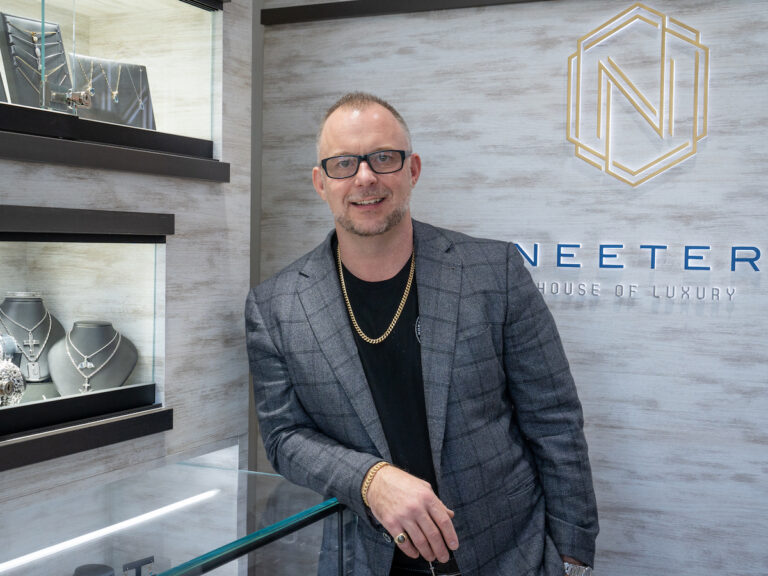
The House of Luxury that John Neeter built

At Neeter House of Luxury, setting plays a stunning role.

Inside the stylish, high-end jeweler’s location is a dazzling arrangement of jewels: a gorgeous Fana diamond halo engagement ring, petite teardrop hoop emerald earrings, love knot ruby-and-diamond bangle bracelets. Wedding bands, Rolex watches, Gucci handbags, along with any desired cut of fancy stone — round, princess or radiant — are artfully lighted and arrayed in custom cabinetry.

The setting of the location elevates the luxury experience. The smart, modern, platinum lines of the storefront are set on Squalicum Harbor, on the northern shore of Bellingham Bay. Sailboats bob up and down, moored in the harbor. Charter boats chug toward the San Juan Islands.

Owner John Neeter, a third-generation private jeweler, saw the gap in Whatcom.

“As an established local jeweler for the past 30 years, I understood that our community was lacking the upscale, elegant, boutique, fine-jewelry experience customers desire,” Neeter said.

With community awards and client reviews pouring in, Neeter delivers one word regarding completing his first year of business at his signature location: “ecstatic.”

“We provide excellence in every area,” Neeter said. “We source from the world’s finest collections of fine jewelry.”

With a full-time jeweler on staff, custom designs can be built in-house. Luxury advisers Sonje and Angelina, with personal warmth and decades in customer service, assist with everything from replacing a watch battery to sourcing a 5-carat, flawless diamond.

Even Neeter’s suppliers, the industry experts who see all the jewelers in the Pacific Northwest through their work of sourcing and delivery, are admiring. Suppliers have said, “You have the most exquisite place north of Bellevue.”

“Our view of the harbor is stunning! Our customers witness awesome sunsets,” Neeter said.

“There are fine dining establishments within walking distance, and, of course, the luxurious Hotel Bellwether.”

What if you want a peek at the collection before visiting the boutique? New clients can view wedding bands and even build engagement rings, along with other custom pieces, on the company website. The online presence — a website that features 40,000 pieces and matches the style of the store — opens a window of transparency, giving clients a sense of quality and cost to enhance personal visits.

The personable owner cited the most important quality for his business: “the experience of every client.”

“Whether someone is getting an appraisal or designing an engagement ring,” Neeter said, “each client should have trust in their jeweler and walk out with a smile.”

“We want to be your family’s jeweler for life,” Neeter said, thinking about all the special occasions marked by fine jewelry, such as engagements, weddings, births, graduations and anniversaries. “We know how to build that commitment and trust.”


—

Neeter House of Luxury provides these collections and services. For a complete experience, visit its location at 21 Bellwether Way, Suite 107, or neeterhouseofluxury.com.

  • Beautifully curated jewelry collections, including estate and vintage
  • Custom designs, with laser welder and CAD/CAM (computer-aided design and manufacturing) on-site
  • Fancy stones in all cuts and shapes
  • Private appraisals for fine, estate and vintage jewelry
  • Professional repair service along with polishing and cleaning and watch battery replacement
  • Jewelry showcases, with designers coming to Neeter to host special events and show their specialty lines
  • Niche items, including luxe handbags, pocketknives and watches